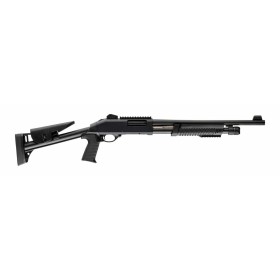
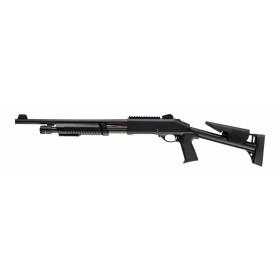
Pump-Action Shotgun: Robustness Above All
We've all seen it in movies: that characteristic clack-clack sound when the pump is cycled. But the pump-action shotgun isn't just a cinema effect. It's a simple, effective, and incredibly reliable mechanism.
- How does it work?
The shooter slides the fore-end back and then forward to eject the shell and chamber a new cartridge.
Key Points:
- Reliability in all conditions (rain, sand, mud, cold)
- Compatible with all sorts of ammunition
- Limited maintenance and mechanical simplicity
- Reduced rate of fire (depends on the shooter's speed)
- Technique to master to avoid feeding issues
Iconic Models
-
Winchester Model 1897: first major success, used since World War I.
-
Remington 870: a timeless classic, produced in over 11 million units.
-
Mossberg 500: sturdy, accessible, adopted by law enforcement worldwide.
In summary: the pump-action shotgun guarantees reliability and versatility, but at the cost of a slower rate of fire.
Semi-Automatic Shotgun: Speed and Comfort
Unlike the pump-action shotgun, the semi-automatic does everything (or almost everything) for you. Once the first shot is fired, the mechanism automatically re-cocks thanks to the energy released.
- How does it work?
Depending on the model, the system uses gas operation or inertia to chamber the next cartridge. Result: a smoother shot without extra movement.
Key Points:
- Faster rate of fire (ideal for driven hunts or migratory game)
- Reduced recoil for more comfort
- Continuous aiming, without interruption between shots
- More demanding maintenance (especially on gas systems)
- Sensitive to very light ammunition
Iconic Models
-
Browning Auto-5: the very first semi-automatic shotgun (1902), produced for nearly a century.
-
Benelli M2: a modern reference in inertia systems.
-
Browning Maxus: a gas-operated semi-auto known for its smooth shooting.
In summary: the semi-automatic is the choice for comfort and quick efficiency, but it requires a bit more maintenance and suitable ammunition.
Pump or Semi-Auto: How to Decide?
Your choice depends on your practice:
-
For an all-purpose, indestructible weapon → the pump-action shotgun remains unbeatable.
-
For effortless consecutive shots → the semi-automatic is the way to go.
-
Regulation-wise: some countries limit the capacity or use of one or the other, a detail to check before any purchase.
Verdict: No Winner, Just Two Philosophies
The pump-action shotgun is about raw power and reliability. The semi-automatic is about fluidity and modernity. Rather than opposing them, it's better to see them as two different responses to different needs.
Many enthusiasts end up owning both, to enjoy the advantages of each depending on the situation.
Products mentioned in this post