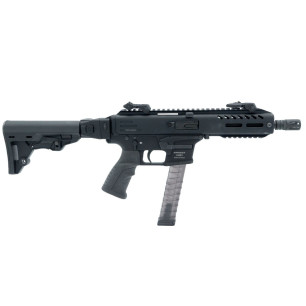
The Illusion of Performance through Accumulation
Each accessory is generally bought with a logical intention: to see better, to control better, to light better.
Taken individually, these choices are coherent. Added without overall reflection, they become counterproductive.
An overloaded weapon leads to:
-
excessive weight at the barrel's end
-
an imbalance of the center of gravity
-
increased shooter fatigue
-
a loss of fluidity in movements
Perceived performance then replaces real performance.
Mechanical Complexity = Multiplication of Failure Points
A simple weapon is a readable weapon.
An overloaded weapon becomes a complex system, where each additional element introduces a risk:
-
screws that loosen
-
rails that become loose
-
optics poorly repositioned
-
batteries forgotten or discharged
-
cables, mounts, or levers that hinder handling
On the shooting range, these problems rarely appear immediately. They manifest at the least opportune moment, often under stress or fatigue.
Professional Accessories ≠ Civilian Use
A large part of tactical equipment is designed for:
-
specific operational environments
-
identified missions
-
trained teams
-
regular maintenance
Transposing these configurations into a civilian or sports context without adaptation is a common mistake.
What is relevant in intervention is not necessarily so for:
-
leisure shooting
-
sports training
-
static precision
-
gesture repeatability
The Impact on Safety
Over-equipment affects not only efficiency but also safety.
Concrete examples:
-
controls that are hidden or hard to access
-
confusion between multiple systems (optics, lasers, modes)
-
slower or clumsy handling
-
errors under fatigue or stress
A weapon that is too complex increases the shooter's cognitive load, which is the exact opposite of safe practice.
Coherence before Accumulation
An effective configuration is based on a simple question:
Does this accessory meet a real, identified, and mastered need?
A well-thought-out weapon:
-
remains balanced
-
maintains accessible controls
-
allows for intuitive handling
-
is 100% understood by its user
Simplicity is often a sign of technical maturity.
Conclusion
The tactical accessory is neither good nor bad in itself.
It is its thoughtless use, guided by aesthetics or imitation, that turns a potential gain into a real handicap.
An effective weapon is not the one that impresses visually, but the one that:
-
remains coherent
-
functions consistently
-
is perfectly mastered by its shooter
In sports shooting as elsewhere, less can truly be more.
Products mentioned in this post