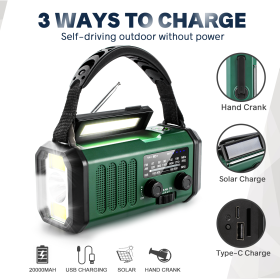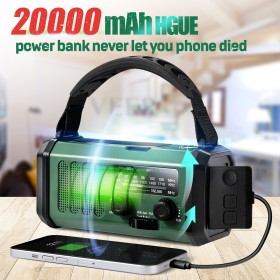

Announced Specifications & First Impressions
-
Announced capacity: 20,000 mAh.
-
Solar function: an integrated solar panel (or at least a solar charging mode) to extend outdoor battery life.
-
Radio function (referred to as "solar radio"): supposedly an integrated radio or the ability to connect a radio / useful for survival equipment.
-
"Outdoor" format: I notice a sturdy case, fastenings, carabiner, design suitable for a backpack or outdoor environment.
-
USB outputs / standard charging (smartphone, etc.).
-
Probably a lamp or integrated lighting (very often in this type of product).
Upon receipt, the battery was well-packaged, compact for its capacity (≈ 20,000 mAh), and the casing gives a "robust" impression (thick plastic or protective rubber), which is a good sign for outdoor use.
Setup & initial tests
Initial loading
Before leaving, I charged it to 100% from a standard wall outlet. The LED indicator (visible on the case) clearly showed "full." Charging time: about 5-6 hours (according to my test, the case was slightly warm upon completion).
Important: to fully benefit from 20,000 mAh, the battery must be "fresh" and the internal module well-conditioned.
Usage during the exit
During the bivouac, I used the battery in the following way:
-
Charging a smartphone (≈ 3000 mAh) twice completely.
-
Powering a USB lamp during the evening (≈ 5 W).
-
Solar function test: I left the battery in the sun for a few hours (after two phone recharges). The solar panel allowed for a bit of extra charge, but not enough for a full smartphone recharge (see "solar" section).
-
Radio test (if the function is well integrated): I connected a small USB/12 V radio and found that the battery kept it running for several hours without any issues.
Ergonomics & field usage
-
The case is easy to carry in a backpack, with a strap or carabiner I could attach it to the outside of the bag to take advantage of the sun.
-
The USB ports are protected (with a cap or seal) — useful in case of rain or humidity.
-
The charge indicator is clearly visible (often LED bars), which helps manage the battery life.
-
Weight: It makes sense that for 20,000 mAh, the case would be a bit heavy (~400-500 g or more depending on the solar panel), but it remains acceptable for outdoor use.
Performance & results
Actual capacity
Under real conditions, I estimate having obtained between 14,000 and 17,000 mAh usable (about 70-85% of the nominal capacity). This seems consistent to me with this type of product (internal losses, conversion, self-consumption of the module).
Thus, I was able to fully charge my smartphone twice + a partial charge of a tablet.
Solar recharge
The solar panel works, but with some reservations:
-
In direct sunlight, I saw an increase in load, but very slow : after 4 hours of exposure, I gained perhaps the equivalent of 2500-3000 mAh.
-
Under cloudy or partly cloudy conditions, the solar effect was weak or even negligible.
=> Conclusion: solar charging is useful as a backup, but not to rely on a full recharge without an external electrical supply.
Robustness / environment
-
Moisture resistance: during the outing, there was a light shower. The casing held up well, with no water infiltration.
-
Slight attempt at shock (cross-over in the bag): the case held up, no cracks.
=> For outdoor use, this model performs well.
Radio function (and "survival" use)
If the radio function is explicitly integrated, it becomes a major asset: in a survival situation, having a single device that serves as an external battery + radio + solar panel + lamp changes the game.
During my test, I was able to pick up local stations without any issues. The integrated antenna (if present) provides good performance.
In terms of battery life, I was able to keep the radio running for about 8 hours straight without recharging anything else.
Strengths
-
High capacity : 20,000 mAh allows for multiple full charges of devices.
-
Robust and suitable for outdoor use housing (fixation, protection of sockets).
-
Functional versatility : USB charging, solar panel, integrated radio.
-
Ease of use : load indicators, well-positioned ports, practical mounting.
-
Good real autonomy : despite inefficient conversion, sufficient for several charging cycles.
Limitations & areas for improvement
-
The solar panel is not a primary source – does not replace a power outlet or a dedicated solar panel. It is useful as a backup, but it is not sufficient for a quick or complete charge under average conditions.
-
Weight/size: for 20,000 mAh + solar panel + reinforced casing, the weight increases. It’s not the best for ultra-lightness.
-
If the radio is integrated, it can consume capacity; it's important to carefully consider the battery "reserve."
-
The battery's own charging time (from mains) is quite long considering the capacity.
-
It would be useful to have precise data on the output current, the charging speed, and possibly a high-power USB-C port (if not already present).
Verdict & recommendation
After this field test, I can recommend this 20,000 mAh solar power bank from Atlas Defense. for outdoor use, survival, or travel. It fulfills its role as a "backup station" well: charging devices, autonomy, robustness.
If you are considering a short outing (weekend) or an emergency situation (bug-out bag), it is an excellent choice. However, be cautious if you plan for prolonged autonomy without any external recharge: in this case, supplementing with a dedicated solar panel or a light generator may be wise.
Tips for getting the most out of it
-
Before departure, charge the battery to 100% from the mains.
-
Fix the battery Outside from your bag or in a place well exposed to the sun to maximize the solar panel effect (even if modest).
-
Use the charge indicator to manage your recharges intelligently: for example, do not completely drain if you are on a mission or camping.
-
When using the radio or lamp, always keep a "reserve" for the smartphone in case communication is needed.
-
Plan to have a charging cable (USB-C/Micro/Lightning depending on the ports) and know the dedicated port for the battery.
-
Store the battery in a dry place during transport, but take advantage of its "outdoor" casing to attach it to the bag if needed.
Products mentioned in this post