



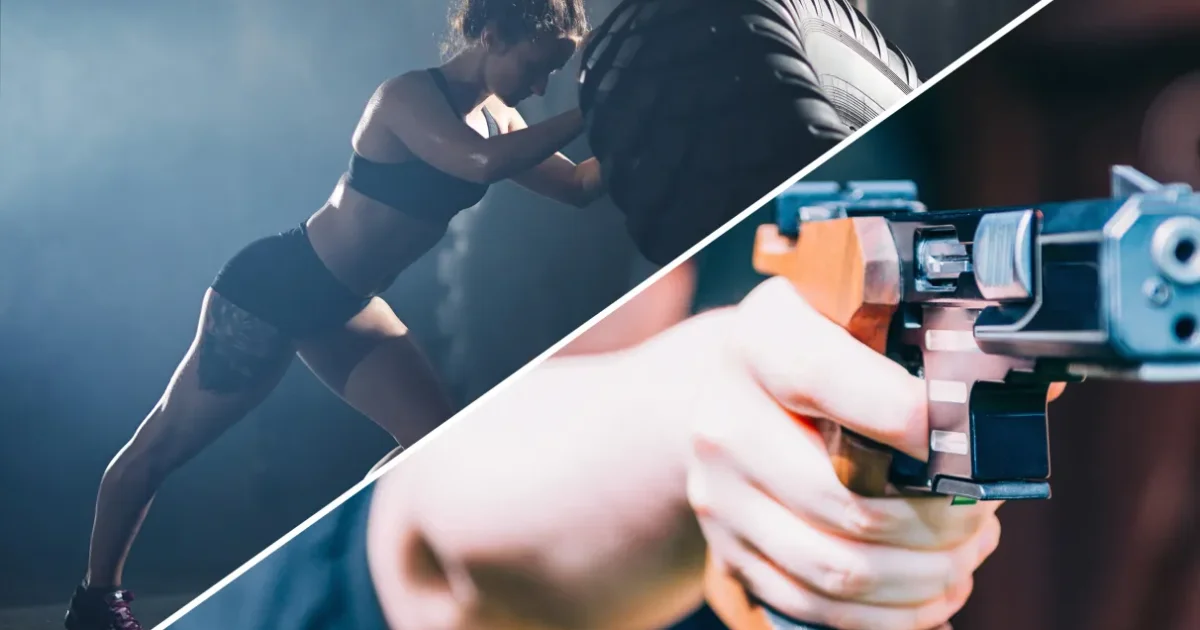
1. Precision: A Balance Between Mental and Physical
Shooting accuracy depends on many factors:
-
The postural stability (standing, kneeling, lying down),
-
The breath control,
-
The stress management (mental and physiological),
-
The maintenance of the weapon and the reduction of muscle micro-tremors.
Key data: A study of Pereira et al., 2011 on 30 sport shooters showed that forearm micro-tremors could increase by 20% after only 5 minutes of holding the position with the weapon, indicating a direct muscular fatigue affecting accuracy.
2. When physical effort changes the game
In a dynamic environment (tactical shooting, IPSC, combat courses, or Tactical Games), fatigue becomes a determining factor.
-
Increase in heart rate: A heart beating at 160-180 bpm causes a visible movement in the optics. Each beat slightly shifts the reticle, disrupting the aim.
-
Shortness of breath: Difficulty in controlling the breathing cycle → more "flinching" (irregular pressure on the trigger).
-
Muscle fatigue: Loss of control at the end, onset of tremors.
Key data: A study published in the Journal of Strength and Conditioning Research (2014) compared two groups of military personnel:
-
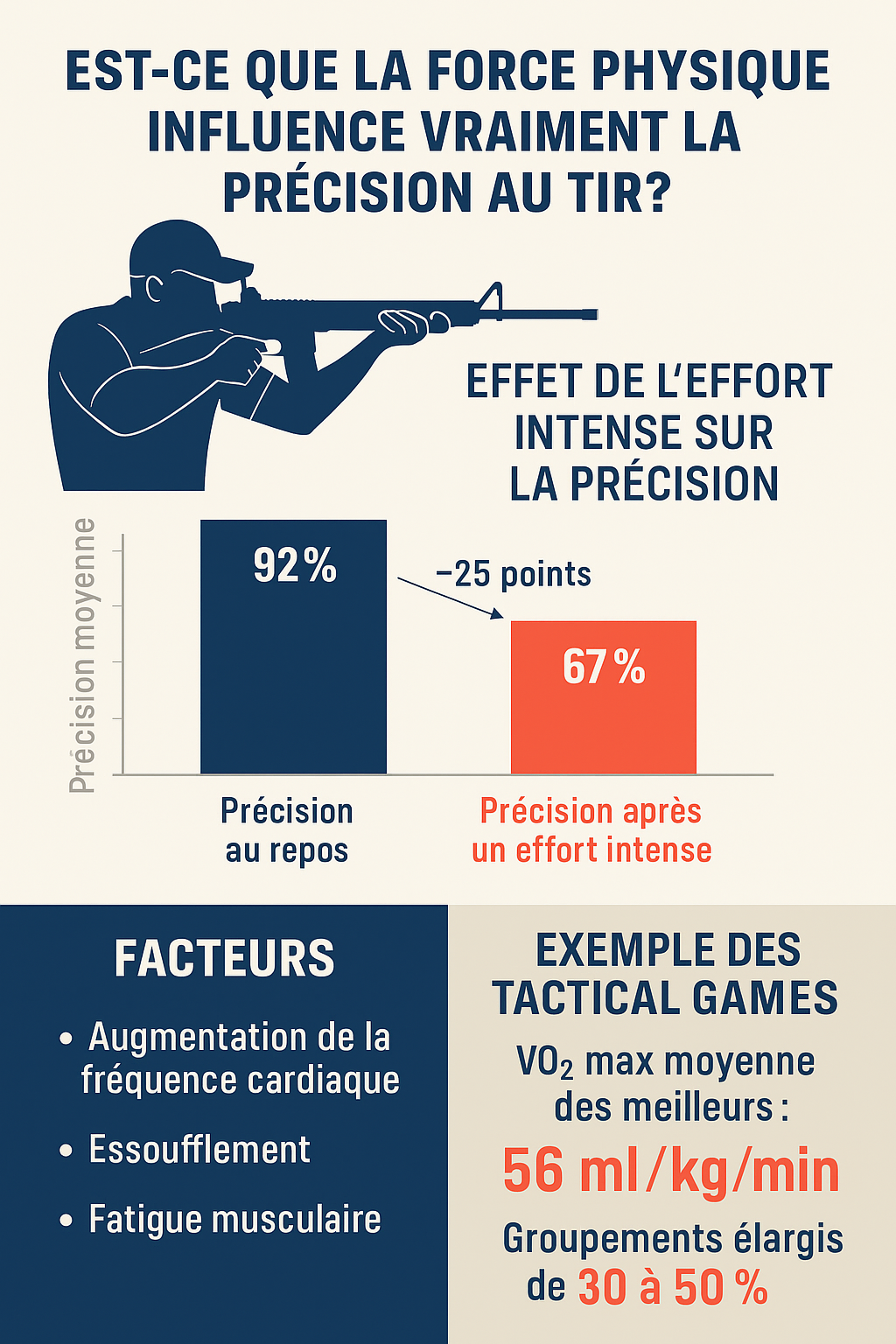
Rest group: average accuracy of 92% on fixed targets at 100 meters,
-
Group after intense effort (400 m sprint + burpees): accuracy dropping to 67%, representing a decrease of 25 points.
3. The example of Tactical Games
The Jeux Tactiques, born in the United States in 2019, combine CrossFit and Tactical shooting. Participants must chain:
-
Strength challenges (carrying sandbags weighing 45 to 70 kg, weighted pull-ups, farmer's carry),
-
Cardio exercises (weighted vest running, sprints, rowing machine, assault bike),
-
And immediately after, sequences of handgun and rifle shooting, at fixed and moving targets.
Observed results:
-
Athletes capable of maintaining accurate performance (>80%) with a heart rate >170 bpm dominate the rankings.
-
During the 2022 edition in North Carolina, the top 5 had an estimated average VO₂ max of 56 ml/kg/min, which is equivalent to that of an amateur triathlete.
-
Less prepared shooters see their groupings widen by 30 to 50% After physical exercises, sometimes completely missing targets at 100 m that would be trivial at rest.
Concrete example (division "Elite Men"):
-
"Sandbag Mile" event (1.6 km with a 55 kg sandbag + rifle shooting): the best maintained 85-90% of hits despite a heart rate >180 bpm.
-
The competitors at the bottom of the rankings were falling to 50-60% of hits, with an increased dispersion of their shots of more than 20 cm at 100 m.
4. Classic target shooting vs. shooting under physical constraint
-
Static shooting sport (10 m, 25 m, 50 m) : brute force plays a small role. However, a balanced musculature and good postural endurance reduce fatigue and improve consistency.
? Olympic shooting champions systematically incorporate light muscle strengthening (core stability, proprioception). -
Tactical/dynamic shooting : physical fitness directly influences the ability to remain accurate under stress.
? In IPSC and 3-Gun, the speed of movement and the recovery of breath between stations determine the quality of the shooting.
? ? Key figure: A study of Hoffman et al., 1992 on military personnel showed that the average dispersion of a shot at 200 m changed from 25 cm to 42 cm after a 2-minute running effort with a weighted vest.
5. Conclusion: Physical strength, an often underestimated factor
Accuracy in shooting is not limited to technique. The Physical strength and athletic preparation are major assets as soon as one moves away from static shooting. The Jeux Tactiques are the demonstration: a strong and enduring shooter, capable of managing their heart rate and breathing, will have a clear advantage over a shooter who is only technical.
For shooting enthusiasts who want to improve, incorporating some muscle strengthening (core strengthening, muscular endurance) and of the targeted cardio (HIIT, running with load) is a promising path.
Today, the complete shooter is no longer just a technician... but an athlete.