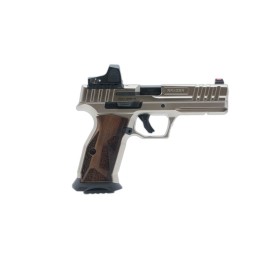
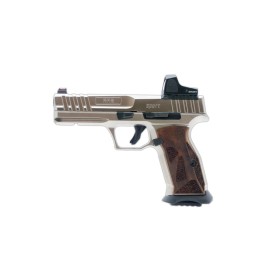
In the US, the right enshrined in the Constitution
"The people have the right to keep and bear arms." This phrase from the Second Amendment summarizes the American spirit.
Adopted in 1791, it aimed to protect citizens against an overly powerful central authority and to ensure their ability to defend themselves.
Today, this translates to a generally permissive legislation:
-
In many states, a simple background check is sufficient to purchase a weapon.
-
The hidden port is permitted in the majority of states.
-
The visible port is legal in several of them.
In France, the exception is the rule.
Here, the principle is reversed: the carrying of weapons is prohibited for civilians.
Possession is strictly regulated:
-
Mandatory legitimate reason (hunting, sport shooting, collection).
-
Prefectural authorization and training.
-
Regular checks.
The carrying in public is reserved for law enforcement and a few professions under threat, after a decision by the Ministry of the Interior.
Comparative box
| Criterion | France | United States |
|---|---|---|
| Constitutional law | ❌ No | ✅ Yes (Second Amendment) |
| Public carrying of firearms | Very rare, exceptional authorization | Authorized in the majority of states |
| Possession of weapons | 31 weapons per 100 inhabitants* | 120 weapons per 100 inhabitants** |
| Main justification | Hunting, sport shooting | Self-defense, tradition, freedom |
| Men killed by firearms/year | ~2.7 per 100,000 inhabitants | ~12 per 100,000 inhabitants |
*Source: Small Arms Survey (2022)
Source: Pew Research Center (2023)
Stories that explain everything
In the United States, guns symbolize independence and autonomy.
The role of weapons in society goes far beyond the simple legal question. For many, they embody independence and the ability to defend oneself by one's own means. This perception is rooted in the country's history: the settlers and then the pioneers lived in areas where the state was distant and protection often depended on the community or the individual themselves. Thus, the weapon became a symbol of autonomy and, in the collective imagination, a tool that guarantees freedom. This vision is maintained by popular culture—films, series, songs—which associates weapons with bravery, resistance, and individual responsibility.
In France, they are seen as a risk to be limited, within a framework where security is ensured by the state.
The relationship with weapons is fundamentally different. The national history is marked by a centralized state, which guarantees public order and collective security. Since the French Revolution, security is considered a sovereign mission: it is the responsibility of the police and the gendarmerie to protect citizens, not for citizens to protect themselves with weapons. This philosophy fosters a cultural mistrust of their circulation among the population. Weapons are not seen as a natural right, but as a potential risk that the state must limit to prevent tragedies. The strict French regulation directly stems from this approach: the fewer weapons in circulation, the more collective security is supposed to be ensured.
Visible consequences
In the United States, the debate focuses on freedom : Should a historical right be restricted ?
For many Americans, limiting gun ownership would mean weakening a fundamental freedom enshrined in the Constitution. Advocates of gun rights believe it is a tool for personal protection and a safeguard against abuses of power. However, in light of the rise in mass shootings and gun violence statistics, a portion of the population and several states are advocating for stricter regulations: enhanced background checks, a ban on certain semi-automatic weapons, and mandatory training. The debate remains intense, as it pits two central values against each other: public safety and individual freedom.
In France, it is about security : how to avoid proliferation and tragedies ?
France focuses on prevention through strict control: limited authorizations, mandatory training, weapon registration, and regular checks. Public carrying remains exceptional, reserved for specific cases and validated by the Ministry of the Interior. Authorities favor the centralization of security means in the hands of the state, believing that fewer weapons in circulation mechanically reduces the risk of violence. This strategy has helped maintain a firearm death rate significantly lower than that observed in the United States.
In summary
Two countries, two logics.
Over there, the weapon is an extension of individual freedom. Here, it is an object under control, reserved for specific uses.
Products mentioned in this post