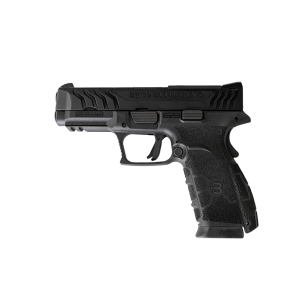
On a semi-automatic pistol, Some parts immediately catch the eye. The barrel, the bolt, relaxation or even the aiming system are visible, commented on, and compared between the different models.
Two much more discreet components nevertheless perform an essential task with each stroke: the extractor and the ejector.
When everything is working properly, the shooter hardly ever thinks about it.
The shot is fired. The bolt moves backward. The casing leaves the chamber and disappears to the side. A new cartridge is then fed, chambered, and the weapon returns to battery.
This entire sequence takes place in a fraction of a second.
But if the extraction or ejection becomes irregular, the operation of the whole system can immediately deteriorate.
A casing remains in the chamber. Another does not properly exit the ejection port. Some travel very far, others fall almost right next to the weapon. In certain situations, a casing can even become partially stuck in the port.
The reflex is then often to talk about an "ejection problem."
However, the ejection is only the final step of a much more complex mechanical chain.
Before being ejected, the cartridge case must first be properly extracted from the chamber, held long enough against the breech face, and then meet the ejector under the conditions specified by the weapon's design.
In other words, The extractor and ejector work together, but they do not accomplish the same task at all..
Understanding their role allows for a better interpretation of how a pistol functions without jumping to quick conclusions.
The extractor and the ejector are not the same part.
The confusion is common.
The extractor is mainly used to grasp the rim or groove of the cartridge case in order to accompany it when the bolt moves backward.
The ejector then acts to cause the casing to be expelled from the weapon.
The principle can be summarized as follows:
The extractor pulls the casing out of the chamber; the ejector helps to push it out of the bolt.
The two operations follow each other so quickly that they give the impression of a single movement.
Mechanically, however, they remain distinct.
It all begins while the case is still in the room.
After the shot is fired, the casing is still found in the chamber.
The pistol's mechanism then begins its cycle in accordance with the weapon's design.
When the barrel and the breech reach the designated phase of their movement, the breech continues its movement backward.
The case must now leave the room.
This is when the extractor becomes essential.
Its functional part is engaged on the rim or in the groove provided on the case.
When the bolt moves back, the extractor therefore pulls the cartridge case backward.
Why must the extractor retain the casing ?
It is not enough to simply remove the casing from the chamber.
During part of the rearward movement, it must remain sufficiently controlled by the bolt.
The extractor helps to maintain its position until the moment when ejection can occur.
If this connection is interrupted too early, the casing may lose its normal trajectory.
The correct operation therefore relies on a very precise sequence:
extraction → retention → engagement with the ejector → exit from the weapon.
Each step depends on the previous one.
The cylinder head surface also participates in this sequence.
The case is not held in place solely by the extractor.
Its base is positioned against the face of the cylinder head.
This geometry helps to control its movement.
The extractor acts on one side while the casing remains pressed against the breech face.
When the ejector operates, this mechanism creates the movement that allows the case to pivot and then leave the ejection port.
The ejection is therefore not simply a case "pushed outward."
It is a movement guided by several surfaces.
The ejector converts the recoil into rotational movement.
On many pistols, the ejector is a fixed part positioned to meet the cartridge case when the slide moves back far enough.
The extractor continues to retain part of the sediment.
The other part meets the ejector.
This difference in support then causes the casing to rotate.
It flips over and exits through the ejection window.
The general geometry of the system therefore directly influences:
- moment of ejection ;
- orientation of the case ;
- exit trajectory.
Why don't the casings just eject straight out ?
Because the extractor holds onto one side of the case head while the ejector acts elsewhere.
The resulting movement produces a rotation.
It is this rotation that allows the cartridge case to be directed towards the breech opening.
Depending on the architecture, cycle speed, and different geometries, the trajectories can vary significantly between two models.
A pistol can eject its casings clearly to the side.
Another one further towards the back.
A third one can present an intermediate trajectory.
This does not automatically mean that one works better than the others.
There is no universally perfect ejection trajectory.
Shooters sometimes like to observe where the casings fall.
This information can be interesting, especially when a weapon that is usually very consistent suddenly starts to exhibit different behavior.
But the simplistic rule must be avoided:
"All my cases must fall exactly in the same place."
Their trajectory depends on many parameters:
- weapon design ;
- bolt speed ;
- ammunition characteristics ;
- weapon orientation ;
- mechanical interaction between extractor and ejector.
A certain dispersion of the cases is therefore not automatically abnormal.
Why do some firearms have an external extractor ?
On many modern pistols, the extractor is visible on the outside of the slide.
Sometimes the room can be clearly distinguished along its side.
This architecture allows the manufacturer to integrate the extractor as a separate component from the bolt.
A spring or an equivalent system generally maintains the pressure as designed.
The advantage for the shooter is not necessarily a better absolute extraction.
It is simply a particular mechanical solution used by many manufacturers.
The internal extractor has also existed for a long time.
Some legacy platforms use a different architecture.
The traditional 1911 is probably the best-known example of an internal extractor.
The part is integrated into the bolt according to a design very different from many contemporary systems.
Both philosophies can work perfectly.
It is therefore not the external or internal position that automatically determines the quality of the mechanism.
As is often the case in armory, The quality of design and execution matters more than the overall appearance of the solution..
Why does the extractor have such a precise shape ?
Its part that comes into contact with the case must perform several functions.
It must be able to:
- hold the case correctly ;
- maintain this relationship during the extraction ;
- let the cycle proceed normally.
The dimensions are therefore determined by the manufacturer.
A slight difference in shape can change the way the case is controlled.
That is precisely why arbitrarily modifying this area is not a trivial intervention.
The extractor works in a very demanding environment.
At each cycle, it undergoes an extremely rapid sequence.
The mechanism is heating up.
Residues appear.
The cases exhibit small dimensional variations within the specified limits.
The room must nevertheless maintain a sufficiently consistent behavior.
It must therefore have several qualities:
- resistance ;
- Elasticity or operation with a spring depending on the architecture ;
- precise geometry ;
- endurance.
A tiny part can thus be subjected to thousands of cycles during the lifetime of a weapon.
The condition of the chamber also influences the extraction.
When a cartridge case must leave the chamber, the extractor is not the only component involved.
The room itself naturally influences the resistance encountered.
The overall condition of the weapon, its maintenance, and the ammunition used can therefore affect the extraction conditions.
It is important because a difficulty in extraction does not automatically prove that the extractor is defective.
Several elements must be considered before identifying a cause.
An extraction problem is therefore not always an extractor problem.
This is probably one of the most useful conclusions.
A case left in the room can immediately suggest:
"Broken extractor."
It is indeed one possibility among others.
But a thorough diagnosis must also take into account the overall condition of the weapon and the circumstances in which the problem occurs.
The shooter's role is not to immediately start modifying the part.
When the anomaly becomes recurrent, a qualified professional can inspect the entire system.
Why can a cartridge case remain partially in the ejection port ?
This type of incident is often colloquially called a "stovepipe" when the casing remains partially stuck in the ejection port.
Visually, the problem seems directly related to the ejector.
However, several factors can disrupt the sequence.
The case must have been:
- correctly extracted ;
- sufficiently controlled ;
- presented to the ejector under the specified conditions ;
- ejected before the bolt returns.
A disruption at different stages can therefore lead to a visually similar result.
The speed of the bolt naturally influences the ejection.
The case is moved by a moving mechanical assembly.
The speed of the bolt at the moment it encounters the ejector therefore necessarily influences its energy and trajectory.
A variation in operation can result in a difference in the way the casings are ejected.
Once again, this does not mean that the springs should be tampered with or the mechanism altered.
This mainly means that an ejection trajectory constitutes a symptom, not automatically a diagnosis.
Ammunition is part of the equation.
Two ammunition references can produce slightly different behavior in the same firearm while remaining perfectly suitable for its operation.
The amount of energy transmitted to the system can influence the cycle.
This is sometimes noticeable simply by the way the casings leave the pistol.
A cartridge producing a slightly different ejection is therefore not necessarily bad.
One must judge above all:
- operation ;
- regularity ;
- compliance with the manufacturer's recommendations.
Why can the cases fall closer when the bolt cycles ?
An energy different from that of the system can change the speed at which the case meets the ejector.
Its trajectory and distance can therefore change.
But it would be dangerous to want to read each case as a perfect measuring instrument.
The shooter's stance and the orientation of the weapon also change slightly.
Observation becomes interesting when a clear, persistent, and reproducible change appears.
Can the way it is handled influence the ejection ?
The way the weapon is held can influence its dynamic behavior.
A semi-automatic pistol operates as a system in which several masses move relative to each other.
A very different outfit can therefore change certain conditions of the cycle.
This does not mean that every variation in ejection is due to the shooter.
But the human factor must not be forgotten when trying to understand irregular functioning.
An excellent extractor cannot compensate for all the other parameters.
One might imagine that an extremely powerful extractor would necessarily guarantee superior performance.
Mechanics is not that simple.
The part must work with:
- room ;
- cylinder head ;
- cylinder head face ;
- Ejector ;
- full cycle.
The system is therefore seeking a balance.
As with springs or head tolerances, "more" is not automatically "better."
Why must an extractor allow sufficient freedom to the cartridge case ?
The case must be able to perform the necessary movement at the moment of ejection.
A consistent mechanical connection is therefore more important than a desire to hold the case with maximum force.
The design establishes how it should be controlled during the cycle.
This nuance once again explains why an improvised modification of the extractor can create more problems than it solves.
The ejector must also be placed precisely.
A fixed part may seem very simple.
However, its position relative to the casing directly influences the timing and direction of the ejection.
A geometric difference potentially modifies:
- point of contact ;
- rotation angle ;
- trajectory.
Manufacturers therefore size this relationship based on the overall architecture of the weapon.
Why do some ejectors appear very long ?
Depending on the platform and its destination, the geometry of the ejector can be different.
Some systems use more or less prominent shapes.
The shooter might be tempted to conclude that a longer ejector will necessarily produce a more forceful ejection.
This is not a universal rule.
The trajectory depends on the whole:
Ejector + extractor + bolt velocity + casing + window geometry.
Comparing only the visible length of two parts therefore has little value.
The ejection window also contributes to the final result.
After being rotated, the case must physically leave the bolt.
The size and shape of the window therefore determine the available space.
Modern pistols sometimes have very different shapes.
Some cylinder heads are widely open.
Others retain more material.
These choices result from the compromise sought by the manufacturer between different design requirements.
Why do we find marks on certain cartridge cases ?
After a session, marks may appear on the cases.
Some come from the normal cycle:
- contacts with the room ;
- extractor ;
- Ejector ;
- cylinder head.
Their presence does not automatically mean that a problem exists.
On the other hand, a sudden and systematic change in the appearance of the cartridges combined with unusual functioning may justify a professional inspection.
The important thing is always the change compared to the normal behavior of the weapon.
Does maintenance affect the extractor ?
Yes, like the rest of the mechanics.
Residues can gradually accumulate in certain areas.
On a regularly used weapon, maintenance in accordance with the manufacturer's recommendations ensures consistent operation.
It is not a question of disassembling every small component after each session.
You simply need to follow the procedures provided for the relevant model.
An unusual accumulation around a functional area can obviously end up having an effect.
Why cleaning aggressively is not necessarily a good idea
A properly designed mechanical part does not need to be ground or modified to be clean.
The objective is to remove the residues according to the appropriate procedure, not to alter the geometry of the part.
The contact surfaces were designed with precise dimensions.
The maintenance must preserve them.
A confusion between cleaning and modification can quickly become problematic.
Wear exists despite the small size of the parts.
Each cycle represents an additional stress.
On a weapon that has been fired a lot, certain parts can gradually wear out.
It is part of the normal life of a mechanic.
The important thing is to differentiate:
- Normal evolution ;
- unusual deterioration.
A damaged, deformed, or malfunctioning extractor must be inspected and possibly replaced according to the appropriate procedures.
Can a broken extractor immediately stop the firearm from functioning ?
Depending on the type of damage, a significant failure can obviously prevent normal extraction.
The casing then no longer properly leaves the chamber.
The operation becomes impossible or extremely irregular.
This is a good example of how a very small part can immobilize an entire platform.
Reliability therefore does not depend solely on the largest components.
Why do competitors monitor ejection so closely ?
In intensive practice, mechanical progress is often more quickly noticeable.
A shooter who uses their weapon extensively generally knows its usual behavior.
He knows approximately:
- How does it cycle? ;
- where the cases tend to go ;
- What sensations are normal?
A clear change can then serve as a signal indicating that a check is useful.
This knowledge of his equipment is different from the obsession of wanting to achieve a perfectly identical trajectory for each case.
Consistency is more important than absolute distance.
Let's imagine two pistols.
The first one sends his cases quite far but in a consistent manner.
The second one projects them much less far but also works perfectly.
It would be incorrect to claim that the first one automatically has a better extraction.
Ejection distance is not a competition.
What matters is that the cycle proceeds normally and regularly.
An extremely violent ejection is not necessarily a sign of quality.
Farther does not mean better.
A casing ejected very energetically simply indicates the result of a set of mechanical parameters.
The best weapon is not the one that shoots the brass the farthest downrange.
It is the one whose operation remains consistent with its design and sufficiently regular over the cycles.
The 1911 platforms and 2011 clearly illustrate the importance of the extractor
In these architectures, discussions about extraction are particularly frequent because the internal extractor is an integral part of their traditional design.
On a properly manufactured and maintained weapon, the system can offer excellent performance.
But it also reminds us that a small part can perform several important functions in the control of the case.
Interventions in this area must therefore be carried out by individuals with the necessary knowledge and tools.
Modern pistols are not without problems either
An external extractor and a modern system do not make a weapon mechanically invulnerable.
Any part can:
- wear out ;
- To be damaged ;
- accumulate residues.
The difference is mainly architectural.
Therefore, conclusions such as the following should be avoided:
external extractor = reliable
where
internal extractor = fragile.
Reality depends on the product and its use.
Can the extractor influence accuracy ?
Its main role concerns the operating cycle rather than the intrinsic accuracy of the barrel.
A weapon that does not function regularly obviously compromises the overall quality of a session.
But the extractor is not normally an element that one seeks to "optimize for grouping."
Its main objective is above all to properly fulfill its role in the feeding and ejection system.
The ejector does not directly improve grouping either.
A clean ejection is important for the reliability of the cycle.
Its function is not to directly reduce the diameter of the impacts on the target.
This is an important distinction because not all parts of a weapon have the same influence on performance.
Some participate mainly:
- To the precision ;
- others to ergonomics ;
- others still to reliability.
Extractors and ejectors are found mainly in this last category.
How can you recognize a normally regular functioning ?
Without trying to analyze each cartridge case down to the millimeter, the shooter can simply know the usual behavior of their weapon.
Does the cycle remain constant ?
Do the casings leave the weapon without incident ?
Is the operation the same from one series to another ?
These are the trends that matter.
An isolated single variation is worth much less than a repeated change.
A single isolated incident is not enough to condemn a part.
A single bad ejection can result from a combination of circumstances.
If the phenomenon never occurs again, immediately replacing several components would make no sense.
Conversely, an anomaly that frequently appears under comparable conditions deserves more attention.
Repetition transforms an event into a trend.
You should always look for the system before the part.
It is probably the best method of thinking.
When something is not working properly, do not immediately ask:
"Which part is broken?"
Ask:
"At which stage of the cycle does the functioning seem different?"
This approach avoids hasty conclusions.
Is the extraction incomplete ?
Is the case still controlled ?
Does the ejection seem to be disturbed ?
These observations can then be passed on to a professional who has the necessary tools to make a proper diagnosis.
Why adjusting the tension or shape of an extractor yourself can be problematic
Because the functional dimensions directly influence the control of the case.
A change that is too significant can turn a functional mechanism into an irregular system.
Without the manufacturer's references and the appropriate control methods, it is difficult to know what geometry has actually been achieved.
As with the previously studied barrel-breech locking surfaces, understanding the mechanism does not mean that it is advisable to modify it yourself.
Same logic for the ejector.
Removing material or arbitrarily changing the shape of an ejector alters its relationship with the case.
This can change the ejection trajectory, but also produce unwanted consequences.
On a regulated firearm used for sporting purposes, functional interventions must remain entrusted to a competent professional.
A gunsmith mainly has means of comparison.
One of the advantages of a professional is not only their experience.
He can compare:
- Actual condition of the parts ;
- dimensions ;
- wear ;
- operation.
It can also determine whether the part is actually the cause or simply the place where the symptom appears.
This difference prevents the unnecessary replacement of multiple components.
Reliability is a chain
A semi-automatic pistol must perform several successive steps.
Very schematically:
departure → cycling → extraction → ejection → feeding → chambering → return to battery.
A problem at one stage can disrupt the following ones.
That is why diagnosing a failure solely based on its final appearance can be misleading.
The case stuck in the window is what you see.
The real cause may have appeared earlier in the sequence.
The perfect functioning is ultimately the one we never think about.
When the extractor and ejector perform their function correctly, the shooter forgets about them.
He pulls the trigger.
The shot is fired.
The case disappears.
The aiming returns.
The cycle begins again.
During a full session, these two small parts can work hundreds of times without attracting the slightest attention.
This is probably the best demonstration of their quality.
Conclusion
The extractor and the ejector are among the most discreet components of a semi-automatic pistol, but their role is essential.
The extractor begins by checking the casing and accompanies it as it leaves the chamber.
The ejector then acts to cause its rotation and its exit through the ejection window.
The operation seems simple when observed in slow motion.
In reality, everything depends on an extremely precise coordination between:
- room ;
- Case ;
- cylinder head face ;
- extractor ;
- Ejector ;
- bolt movement.
This interaction explains why an incident visible at the ejection window is not automatically caused by the ejector.
Similarly, a poorly extracted casing is not enough to immediately condemn the extractor.
Ammunition, maintenance, mechanical condition, and the general behavior of the cycle can all play a role.
The trajectory of the casings sometimes provides interesting information, especially when a weapon that is usually consistent suddenly starts to behave differently.
But we must avoid turning this observation into an automatic diagnosis.
The cases do not need to form a perfect grouping on the ground.
What we are looking for is above all a coherent functioning.
Finally, the extractor and the ejector recall a fundamental rule of gunsmithing mechanics: The size of a room does not correspond to the importance of its function..
A few millimeters of metal are enough here to determine whether the casing ejects properly from the weapon and if the cycle can continue normally.
When everything is working, no one notices their presence.
When an anomaly occurs, the entire platform can be immobilized.
It is precisely for this reason that these small parts deserve to be understood, maintained according to the manufacturer's recommendations, and checked by a professional when an unusual behavior becomes repetitive.
FAQ
What is the difference between an extractor and an ejector ? The extractor controls and removes the casing from the chamber while the ejector then helps to expel it from the weapon.
Does the extractor completely remove the cartridge case from the firearm ? He accompanies it out of the chamber and controls it during part of the cycle; the ejector then helps its exit from the bolt.
Why does the casing rotate during ejection ? The extractor holds part of the base while the ejector acts on another area, causing it to rotate.
Do all pistols have the same extractor system ? No. Different architectures exist, including internal or external extractors.
Is an external extractor necessarily more reliable ? No. Reliability depends on the design and the overall quality of the system.
Why does the 1911 have an internal extractor ? This is part of its historical mechanical architecture.
Does a poor ejection automatically mean that the ejector is defective ? No. Extraction, bolt speed, ammunition, and several other factors can produce similar symptoms.
Why can a cartridge case get stuck in the ejection port ? The extraction and ejection sequence may have been disrupted at different stages of the cycle.
Can ammunition alter the trajectory of casings ? Yes. A variation in the cycle behavior can influence the energy and direction of the ejection.
Can the shooter's grip influence the cycle ? It can modify the dynamic behavior of certain semi-automatic weapons.
Do the cases all have to fall exactly in the same place ? No. Some variation is normal and depends on many parameters.
Does a very powerful ejection indicate a better weapon ? No. The distance traveled by the casings is not a direct measure of quality.
Can clogging disrupt extraction ? Yes. A significant accumulation of residues can alter certain operating conditions.
Is it possible to modify an extractor yourself to improve ejection ? Modifications to the functional surfaces can alter the behavior of the weapon and should be entrusted to a qualified professional.
Can an extractor wear out ? Yes. Like any mechanical part under stress, its condition can change over a large number of cycles.
Can a broken extractor prevent the weapon from functioning ? Yes. A significant malfunction can prevent the case from leaving the chamber normally.
Does the extractor directly influence accuracy ? Its main function concerns the reliability of the cycle rather than the intrinsic accuracy of the barrel.
When should the system be checked ? When an extraction or ejection anomaly becomes repetitive or when a usual behavior suddenly changes.
Products mentioned in this post