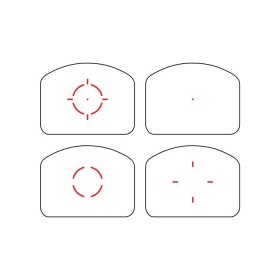
The red dot Move. The handlebar oscillates slightly. The rifle never remains perfectly still. You then wait for everything to stop before pressing down on... the trigger tail.
A second passes.
Then two.
You hold your breath more. You tense your shoulders. You grip the handle more tightly. The movement briefly decreases, then returns, sometimes more intense than at the start.
The shot ends up going off at the very moment when you actually feel like you have lost your balance.
It is one of the most common paradoxes in shooting sports: The more some shooters try to absolutely immobilize their weapon, the more they create conditions that enlarge their grouping.
A weapon held by a human being is never perfectly still.
The body breathes.
The heart beats.
The muscles are working.
The joints continuously make tiny adjustments.
Even for an experienced shooter, aiming still involves some movement.
The difference between a consistent shooter and a shooter who struggles with their weapon does not necessarily come from the absence of movement. It mainly comes from their ability to accept a reasonable stability zone and make a clean start within this zone.
This distinction completely changes the way precision is approached.
The goal is no longer to wait for a miraculous moment during which the weapon would become perfectly still.
It involves understanding one's movement, reducing unnecessary tension, and properly coordinating relaxation with sufficient stability for the difficulty of the target.
A weapon Handheld posture cannot be perfectly still.
Just try to keep your hand stretched out in front of you.
Even without holding an object, she makes tiny movements.
Add the weight of a pistol, a position to maintain, breathing, and visual concentration: the oscillations become inevitable.
With the rifle, supports greatly reduce certain movements, but they never eliminate them completely.
Searching for absolute zero motion therefore amounts to pursuing a physiologically unrealistic goal.
The shooter can reduce the oscillations.
He can improve his position.
He can make his movement more regular.
But he cannot transform his body into a mechanical vise.
The problem is not always that your weapon moves.
The real question is:
In which area is she moving ?
A red dot moving slowly within a relatively small area can be perfectly consistent with an excellent shot.
Conversely, a point that seems almost motionless for a fraction of a second but then makes large, sudden movements can be much more difficult to exploit.
It is therefore necessary to distinguish:
- amplitude ;
- speed ;
- regularity.
A small regular oscillation is generally much easier to manage than a chaotic movement caused by muscular corrections.
The red dot reveals what the mechanical organs sometimes concealed
With a riser and a handlebar, the movements already exist, but the shooter can less easily perceive their exact amplitude.
The red dot makes them extremely visible.
It is floating.
He is drawing small circles.
It rises slightly with breathing.
He is coming back.
Some shooters then discover with concern an instability that they already had.
The red dot did not create the movement.
It simply shows it to you with much more precision.
That is why the first reaction should not be to try to fix the point at all costs.
The more you watch the movement, the more it can seem important.
Vision plays a significant role.
When you stare intently at the red dot, trying to detect the slightest movement, your perception becomes extremely sensitive.
A movement that would have been considered insignificant suddenly becomes huge.
The shooter then begins to intervene.
He corrects on the left.
Then to the right.
Then slightly higher up.
The system that was naturally oscillating begins to receive a series of voluntary commands.
The movement becomes less fluid.
This is the beginning of the fight against the weapon.
Permanent correction often creates more movement.
Your point moves slightly to the left.
You push the weapon to the right.
But the body has inertia.
The correction continues slightly too far.
You come back to the left.
A new correction appears.
In a few seconds, a small natural oscillation can turn into a much larger movement.
It’s exactly the same principle as when making small excessive corrections with the steering wheel.
The problem is no longer the initial trajectory.
These are the successive corrections.
Stability does not mean immobility
This is probably the main point of this article.
A stable position is not a position in which nothing moves.
It is a position in which the movement remains:
- limited ;
- predictable ;
- reproducible.
If your aim naturally stays within an area corresponding to the required precision, your stability can be excellent even if it continues to move.
The pursuit of performance then involves gradually reducing this zone and learning to make a smooth start without disrupting this movement.
The acceptable range depends entirely on the target.
There is no universally correct range of motion.
A large target nearby does not require the same precision as a small area located much farther away.
The amount of stability required must therefore be adapted to the difficulty.
It is a fundamental concept in sport shooting.
If the target allows you some leeway, waiting for perfect stillness does not benefit you.
You are simply wasting time and increasing the risk of worsening your position.
Conversely, a demanding target justifies more preparation and a smaller stability zone.
The shooter must learn to recognize "sufficiently stable."
It is an essential skill.
Instead of asking:
"Is my weapon perfectly still?"
ask yourself:
"Is my movement sufficiently controlled for the result I am looking for?"
This question is much more useful.
It requires linking the quality of the aiming to the actual difficulty of the shot.
The shooter stops seeking abstract perfection.
He is looking for useful information.
Waiting too long often worsens the position.
At the beginning of the sequence, the position may be correct.
The breathing is calm.
The muscles are working normally.
The point enters a relatively stable zone.
Then the shooter waits.
He wants even better.
A few seconds pass.
The muscles are starting to fatigue.
The breathing becomes more urgent.
The vision becomes strained.
The movement increases.
The shooter has just missed his best window of stability while waiting for a situation that will probably never come.
The best moment is not necessarily when the point seems the most still.
A moment of apparent stillness can be created by a significant muscle contraction.
The point stops.
The shooter thinks:
"Now!"
But at the same moment, he abruptly triggers the release.
The overall contraction changes.
The weapon fires again.
The shot goes outside the targeted area.
Conversely, a slightly mobile aim combined with a progressive trigger pressure can produce a better result.
The quality of the start matters more than a spectacular image for a fraction of a second.
Prolonged apnea further amplifies the problem
We have already seen that a reasonable breath hold can facilitate shooting.
But when you wait too long for your perfect moment, this pause is extended.
The need to breathe increases.
Tensions are arising.
Stability is beginning to deteriorate.
The shooter then hesitates between two bad options:
- force the shot ;
- continue to wait.
That is why knowing how to interrupt a sequence is just as important as knowing how to start it.
Abandoning a start is not a failure.
If your stability clearly deteriorates and the shot has not yet been fired, it may be better to restart your sequence under the conditions required by your discipline.
Some shooters consider this a fault:
"I was almost on it, I had to shoot."
This logic often leads to forced departure.
Calmly rebuilding a good sequence can be much more effective than saving a poor preparation.
Discipline also involves recognizing when the conditions are no longer satisfactory.
Relaxation must progress while aiming is active
One of the classic mistakes is to completely separate aiming and trigger control.
The shooter first seeks stillness.
Only when he believes he has found it does he begin to act on the trigger.
This organization often creates a late and voluntary departure.
A more effective approach is to coordinate the two phenomena.
The aim gradually stabilizes.
The departure is also gradually taking shape.
The goal is for the action on the trigger not to cause a sudden break in the achieved stability.
Why waiting and then "forcing" the departure destroys the benefit gained
Imagine that you spent several seconds reducing your oscillation.
The dot finally arrives exactly at the center.
You then decide:
"Now!"
The finger accelerates abruptly.
The hand reacts.
The position changes slightly.
You have just disrupted precisely the moment you were trying to preserve.
This is one of the mechanisms explaining why some shooters paradoxically achieve better shots when they stop trying to trigger exactly at the center.
The start must become predictable in its quality, not necessarily in its microsecond.
The goal is not to be artificially surprised by one's weapon.
The goal is to apply consistent pressure without causing any unintended movement.
You know that the departure is approaching.
But you do not produce a sudden muscular command at the moment the point passes through a precise position.
This regularity reduces the risk of moving the weapon at the last moment.
The search for the absolute center can create a hesitant relaxation.
The dot arrives at the center.
The shooter starts the pressure.
The point sticks out slightly.
He stops.
The point comes back.
He is starting again.
Then he stops again.
This sequence of decisions sometimes creates an irregular relaxation.
The finger becomes directly dependent on every micro-movement of the aiming.
Instead of a continuous and controlled action, the start becomes an ongoing negotiation with the red dot.
Accepting a range of motion simplifies relaxation.
When the shooter accepts that their aim naturally shifts within a sufficiently precise area, they can maintain a much more consistent action.
He no longer tries to synchronize a sudden reaction with a precise passage.
The whole becomes smoother.
The aim is moving.
The relaxation is progressing.
The shot is fired without deliberately disturbing the weapon.
This coordination is generally much more reproducible.
The natural aiming position becomes essential again.
If your body is poorly positioned, the weapon naturally tends to leave the target.
You compensate with your arms.
The movement increases as soon as you slightly release the tension.
In this situation, simply accepting the oscillation is obviously not enough.
The structure must be corrected first.
A good position helps reduce movement without creating excessive muscular effort.
Natural stability must precede the management of departure.
The goal is therefore not to accept a bad position.
It would be incorrect to interpret this article as:
"Let the weapon move and shoot anyway."
The logic is different.
Avoidable movements must be reduced as much as reasonably possible through:
- position ;
- Balance ;
- getting started ;
- breathing.
Then accept the residual movement that naturally remains.
The difference is essential.
A grip that is too tight can create a false sense of stability.
When using a pistol, gripping very tightly can temporarily give the impression that the weapon moves less.
But if this pressure exceeds what you can comfortably reproduce, several problems arise.
Muscles get tired.
The tremors are increasing.
The pressure of the hands becomes less consistent.
You may gain a second of apparent stability only to lose much more consistency afterward.
A good grip must be firm and consistent according to the technique used, but above all reproducible.
A socket that is too weak is obviously not the solution.
The goal is not to completely release the weapon.
The grip must remain suitable for the type of weapon and the discipline.
What poses a problem is especially the contraction added solely in the hope of freezing the system.
This additional voltage is not always useful.
It can even change the weapon's behavior from one shot to another.
The shoulders are often the first to tense up.
Observe your posture when a shot is delayed.
The shoulders sometimes start to rise.
The neck becomes stiffer.
The arms stretch out further.
The shooter unconsciously tries to create stability by adding tension everywhere.
However, a more tense structure is not necessarily more stable.
She often becomes more sensitive to fatigue and tremors.
Fatigue turns a small oscillation into a large movement.
At the beginning of a series, your zone of stability may be relatively small.
Over the course of the shots, it can gradually widen.
This does not automatically mean that your technique is falling apart.
Your body is simply tired.
The problem arises when one tries to compensate for this fatigue by contracting even more.
The movement then becomes more irregular.
Recognizing fatigue helps prevent turning a normal decrease in stability into a bad technical habit.
The gaze also grows tired.
Vision is not perfectly steady during a long session.
The concentration decreases.
The eye may have more difficulty maintaining the same level of attention.
A shooter may then believe that their weapon is moving more, while their perception of the movement itself has changed.
Breaks and a reasonable organization of training can therefore contribute as much to the quality of shooting as the constant pursuit of better posture.
With the rifle, The phenomenon remains present despite the supports.
A bag, a bipod, or a prone position greatly reduce certain movements.
But the system remains human.
Breathing affects the contact with the stock.
The pressure of the cheek can vary.
The shoulder can slightly change the position.
Trying to fully constrain the rifle can also create stresses.
The repeatability of the contacts generally remains more important than the force used to immobilize the assembly.
Support should not become a means of fighting against the weapon.
A good support allows for building a more stable position.
But if you constantly push or pull the weapon to keep the reticle centered, you recreate exactly the same problem.
The position should naturally bring the aim into the desired area.
If the weapon continuously wants to move elsewhere, it is often necessary to rebuild the position rather than increase the force.
The reticle of a scope he moves too
At high magnification, the slightest movement becomes spectacular.
A movement that seemed tiny at low magnification suddenly takes on enormous visual significance.
The shooter can then think that he has lost all stability.
However, the magnification has not necessarily increased the actual movement in the same proportions.
He mainly enlarged what you see.
It is exactly the same perceptual trap as the red dot, but even more pronounced.
The more the image is magnified, the more you need to know how to interpret the movement.
An extremely magnified reticle can make you want to constantly adjust.
The shooter then "drives" his reticle towards the center.
He ends up overtaking.
He is coming back.
The aiming becomes artificially shaky.
A good position should allow the reticle to naturally remain within a small area without constant deliberate correction.
The best shots are not necessarily those that seem perfect.
It is a common experience.
A shot seems average to you.
The point was moving slightly.
The departure took place without any spectacular event.
You are looking at the target: excellent impact.
A few minutes later, you build a sight that seems absolutely perfect to you.
You are waiting.
The point stops.
You trigger intentionally.
The impact is less good.
This reminds us that the aesthetic sensation of aiming is not enough.
The start and overall repeatability remain essential.
Your target must confirm what you feel.
Do not try to adopt a method simply because it seems more comfortable.
Observe your results over several series.
When you stop forcing stillness, do your groupings become more regular ?
Are long-range shots decreasing ?
Is your sequence easier to reproduce ?
The target allows you to verify if your new perception actually produces an improvement.
A single excellent grouping is not enough.
As always in shooting sports, repeatability must remain the standard.
An exceptional grouping may appear occasionally.
What matters is your ability to consistently reproduce a similar quality.
An approach that allows for five consistent series is often more interesting than a method producing one fantastic series followed by several mediocre ones.
One must distinguish between precision and obsession with the center.
A shooter can be extremely focused on the center of the target without improving their accuracy.
The performance mainly comes from the repeatability of the whole system:
- position ;
- aim ;
- relaxation ;
- follow-up.
The center indicates where you want to send the impacts.
It must not trigger a series of muscle reactions as soon as the aiming system moves away from it slightly.
The aiming area must become familiar.
With experience, the shooter gradually learns to recognize what their usual movement allows.
He knows that a certain oscillation is normal.
He also knows how to recognize when it truly becomes excessive.
This knowledge reduces anxiety.
The red moving dot no longer automatically triggers a correction.
The shooter observes.
He decides if the available stability is sufficient.
Then he continues or restarts his sequence.
This skill is also mental.
Accepting movement sometimes requires more trust than technique.
Instinct drives one to control.
When something moves, we want to stop it.
Sport shooting, on the other hand, requires accepting a certain amount of movement while maintaining a fine control over the trigger.
It may feel uncomfortable at first.
But this acceptance often allows for a considerable reduction in unnecessary movements.
Why do a stopwatch or the pressure of the result amplify the problem ?
When the shooter feels pressured, two opposite reactions can occur.
He triggers too early without having built his stability.
Or he becomes, on the contrary, obsessed with the need to produce a perfect shot and waits far too long.
In both cases, coordination is disrupted.
Training should enable recognizing sufficient stability without rushing or excessive waiting.
The first stability window is often the best.
After properly establishing the position and aiming, many shooters notice an initial period during which their movement is relatively steady.
If they let it pass while still looking for something better, stability can gradually deteriorate.
It is therefore useful to learn to recognize this window.
Not to trigger at all costs.
But to avoid unnecessarily prolonging a sequence that was already usable.
Individual rhythm exists
Not all shooters have exactly the same comfortable window.
Morphology, physical condition, experience, and discipline influence the length of time a position remains optimal.
The goal is therefore not to precisely copy the rhythm of another shooter.
One must understand one's own.
A good sequence should be able to be performed naturally without becoming a race against time.
How can we work on this concept without artificially seeking speed ?
During your usual sessions and within the rules of the range, the objective can simply be to observe.
Build your position normally.
Watch how your aiming system moves.
Try to distinguish:
- natural oscillation ;
- voluntary correction ;
- voltage.
The goal is not to accelerate immediately.
It is to identify the moment when you begin to struggle against your own movement.
This awareness can already profoundly change the technique.
Filming can also reveal tensions.
A video does not precisely show the movement of the red dot, but it can reveal:
- shrugging shoulders ;
- contractions ;
- excessive duration of retention.
You can sometimes discover that a shot you thought was perfectly calm actually required a long period of tension.
This information makes it possible to link internal sensations with actual behavior.
The announced shot becomes once again very useful.
After leaving, try to identify what you saw.
Was the point located in your usual area ?
Did you feel a sharp correction ?
Have you accelerated the relaxation ?
Then only compare with the impact.
Over time, you develop a much more precise relationship between:
What you see and what your shot actually produces.
It is much more useful than searching for a theoretically perfect aiming image.
Safety and the sporting environment remain priorities.
All technical work must naturally remain in accordance with the rules of the stand, your discipline, and the supervision instructions.
Seeking more fluidity never means speeding up at the expense of control.
Understanding movement helps make shooting more consistent, not to eliminate basic safety principles.
Conclusion
Why can trying to perfectly immobilize your weapon increase your groupings ?
Because absolute stillness practically does not exist when a weapon is held by a human being.
Your breathing, your muscle activity, and the micro-corrections necessary for balance always produce some movement.
The problem begins when you refuse this movement.
You contract your arms more.
You shrug your shoulders.
You hold your breath longer.
You start to correct every little oscillation.
The natural movement, initially limited and predictable, gradually becomes broader and more irregular.
Then, after waiting several seconds for a "perfect" moment, you suddenly trigger as soon as your aiming system crosses the center.
You have sometimes just created yourself the very error you were trying to eliminate.
The right approach is not to accept just any instability.
A natural position, a consistent grip, proper balance, and controlled breathing remain essential.
But once these fundamentals are in place, one must accept that a residual movement exists.
The real skill then lies in understanding whether this movement remains sufficiently controlled for the difficulty of the shot.
A large nearby target does not require the same stability as a small distant area.
The required level of information must therefore be adapted.
The relaxation can then progress without waiting for a moment of artificial stillness.
And if stability truly deteriorates, properly restarting the sequence is often preferable to forcing a bad start.
In the end, accuracy is not achieved when one miraculously manages to stop their weapon.
It appears when position, natural movement, aiming, and trigger control become sufficiently consistent to produce the same result over and over again.
Your weapon will always move a little.
True progress begins when you stop seeing this movement as your enemy.
FAQ
Is it normal for my red dot to move on the target ? Yes. Some oscillation is normal when a weapon is held by a human being.
Should you wait until the red dot is perfectly still before shooting ? No. Absolute immobility is rarely realistic; the goal is sufficient stability for the difficulty of the target.
Why does my red dot move more when I wait ? Muscle fatigue, breathing, and increased tension can gradually widen the oscillation.
Why doesn't gripping harder always stabilize the weapon ? An additional contraction can cause fatigue and trembling and make the grip less consistent.
What is a stability zone ? This is the area in which your aiming system naturally operates when your position is properly established.
Does a small oscillation prevent one from being precise ? No. A limited and regular oscillation can perfectly be compatible with excellent grouping.
Why do I sometimes shoot better when I feel like my aim wasn't perfect ? Because a smooth start during a slight oscillation can be better than a sudden start made after a long wait.
Should it be triggered as soon as the point crosses the center ? Trying to trigger abruptly at this moment can disrupt the weapon; the quality of the action on the trigger remains essential.
Why do my shoulders tense up when I wait too long ? Your body tries to artificially increase stability by adding muscle tension.
Does breathing influence oscillation ? Yes. A breath hold that is too long can gradually impair your stability.
Can we abandon a shooting sequence that has become bad ? Yes. When stability clearly deteriorates, properly reconstructing the sequence may be preferable to forcing the start.
Does the phenomenon also exist with the rifle ? Yes. The supports reduce movement, but the shooter's breathing, contact, and tension continue to influence the weapon.
Does a high magnification give the impression that one is moving more ? Yes. Magnification makes movements that already existed appear much larger visually.
How can I tell if my oscillation is acceptable ? It must be compared to the precision required for the target and to the results you actually obtained.
Why do my corrections sometimes amplify the movement ? Each correction can slightly overshoot its target and cause a reverse correction, creating a larger oscillation.
Does a good position reduce movement ? Yes. A natural and balanced position generally helps to reduce tension and contain oscillation.
Should we only look at the red dot ? The point provides useful information, but hyper-focusing on every micro-movement can lead to excessive corrections.
What is the priority for improving its groupings ? Seek a position and a sequence that are reproducible rather than perfect immobility, which is impossible to maintain.
Products mentioned in this post