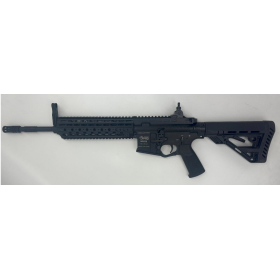
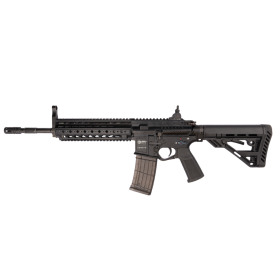
Two rifles Of the same model. Same caliber. Same barrel length. Same ammunition box. Same shooting session. Yet, when you set up a chronograph in front of each one, the results can be different.
The first one, for example, shows a slightly higher average. The second one gives a lower speed, sometimes by a few meters per second, sometimes more.
For many shooters, this difference seems abnormal. The same ammunition should logically produce the same velocity in two identical firearms.
In reality, it is almost never that simple.
A cartridge does not produce a fixed velocity regardless of the firearm in which it is fired. The velocity measured at the muzzle results from a complex balance between the ammunition, the chamber, the barrel, friction, dimensional tolerances, and firing conditions.
Two rifles coming off the same production line can therefore exhibit slightly different behaviors.
That does not mean that one is defective.
This simply means that a barrel is a real mechanical part, manufactured with tolerances, and not a theoretical value perfectly identical from one piece to another.
Understanding this phenomenon also helps avoid several mistakes: blindly comparing your speeds with those indicated on a box of ammunition, automatically considering a "fast" barrel as better, or unnecessarily modifying a perfectly functional setup.
The right question is therefore not: "Why does my weapon not deliver exactly the advertised velocity?"
She is rather: "What factors can explain the actual velocity achieved in my cannon?"
The speed indicated on a box is not a universal guarantee.
When a manufacturer specifies a velocity for ammunition, this value comes from specific test conditions.
It depends in particular on the barrel used for the measurements, its length, and the conditions under which the tests were conducted.
Your rifle does not necessarily have exactly the same characteristics.
Even when the stated length appears to be the same, many differences remain.
The test barrel may have a slightly different internal diameter, a different chamber, or a particular surface finish.
The temperature during the tests can also differ.
The speed indicated on the packaging therefore serves as a useful reference, but it cannot be considered as the guaranteed speed for all firearms.
Your chronograph measures your system, with your weapon, your ammunition supply, and the conditions of the day.
That is precisely what makes this measure interesting.
Two cannons of the same caliber are never perfectly identical.
A barrel is manufactured according to precise dimensions, but these dimensions necessarily have tolerances.
Let's take two barrels chambered in the same caliber.
On paper, they are identical.
In reality, the diameter of certain areas can vary by a few hundredths or thousandths depending on the manufacturing method and the tolerances applied.
These differences are extremely subtle to the naked eye.
But they can influence the way the projectile moves.
A slightly tighter barrel can generate more friction and alter the pressure during the projectile's movement.
Another one may offer a slightly different resistance.
The final velocity results from this balance between the pressure generated by the gases and the forces that slow down the projectile.
Sometimes, just a few dimensional differences are enough to produce measurable results on the chronograph.
The actual diameter of the core can influence the result.
The caliber indicated on the weapon does not describe every actual dimension of the barrel with absolute precision.
In a rifled barrel, it is important to distinguish several internal dimensions.
The projectile is guided and deformed by the rifling as it moves forward.
The force required to accomplish this work depends on the actual geometry of the barrel.
If two barrels have very slight differences in groove diameter or depth, the friction will not be exactly the same.
This can change:
- the increase in pressure ;
- the duration during which this pressure acts ;
- the acceleration of the projectile ;
- the velocity obtained at the mouth.
These discrepancies generally remain moderate on two compliant weapons, but they show why the notion of "two identical barrels" must be put into perspective.
The room also plays a role
The speed does not depend solely on the striped part.
Even before the projectile actually moves forward in the barrel, the cartridge is in the chamber.
Its dimensions and the way the cartridge is positioned in it can influence the start of the ballistic cycle.
A chamber that is slightly different within tolerances can change the way the case expands and how the pressure develops.
It should obviously not be concluded that a tighter chamber is systematically better or that a more generous chamber is bad.
A weapon must above all remain compliant with the specifications provided by its manufacturer and the applicable standard.
But these variations explain why two weapons, even though they come from the same model, may not produce exactly the same data.
The groove engagement cone influences the start of the movement.
We have already discussed on the Atlas Defense blog the role of the groove pick-up cone, this area located between the chamber and the rifled bore of the barrel.
This part is particularly important because the projectile makes the transition there between its initial position and its engagement with the rifling.
The length of the freebore, the geometry of the rifling engagement, and the distance traveled before full engagement can alter the pressure behavior.
Two theoretically identical cannons can exhibit small manufacturing differences in this area.
The projectile can therefore encounter the grooves slightly earlier or slightly later.
This influences the start of its resistance to movement and can contribute to small differences in speed.
This phenomenon is precisely one of the reasons why it is dangerous to try to interpret a velocity solely based on the caliber and the length of the barrel.
The friction is not exactly the same in all barrels.
As it moves through the barrel, the projectile encounters resistance.
This resistance depends notably on:
- of the actual diameter ;
- about the geometry of stripes ;
- of the surface condition ;
- materials ;
- of clogging.
A barrel with a very smooth surface can exhibit behavior slightly different from another barrel of the same model.
This does not allow for simply predicting which one will produce the highest speed.
Internal ballistics is not simply "less friction always equals more speed."
Pressure, sealing, and the behavior of the projectile interact.
What matters is that the whole remains coherent and consistent.
The new barrel can change during its initial uses.
A new barrel is not necessarily exactly in the same condition after several hundred shots.
The initial passages of projectiles can slightly alter certain microscopic irregularities left by the manufacturing process.
The fouling also evolves.
A shooter can therefore observe a slight change in velocity during the initial life of the barrel.
This change is not necessarily significant and is not the same across all models.
It simply reminds us that a canon is not a completely fixed element.
It gradually transforms with use.
Clogging can alter the behavior.
The number of shots fired since the last cleaning can also influence the measurements.
Combustion residues and deposits can very slightly alter the internal conditions.
A perfectly cleaned barrel does not always behave exactly the same as the same barrel after several stabilization shots.
This is one of the reasons why a serious comparison must be carried out under conditions as close as possible.
Comparing the speed of a perfectly clean rifle with that of a second one that has already fired fifty cartridges introduces an additional variable.
That does not mean that you have to clean constantly.
This simply means that one must know the state of both systems when comparing data.
The length of the barrel doesn't tell the whole story.
Length is obviously one of the best-known factors influencing speed.
As a general rule, a certain length allows the gases to continue accelerating the projectile for a longer time, until other factors limit the benefit.
But two barrels announced with the same length can nevertheless produce different speeds.
Why ?
Because length does not determine:
- the actual diameter ;
- the room ;
- the occurrence of scratches ;
- surface condition ;
- friction.
Two tubes of 51 cm are therefore not necessarily ballistically identical.
Length is an important parameter, not a complete description of the barrel.
The same batch of ammunition is essential for comparison.
Another source of error comes from the ammunition itself.
Two boxes bearing exactly the same commercial reference may come from different batches.
Manufacturers obviously maintain their productions within defined specifications, but small industrial variations may exist.
To truly compare two weapons, it is better to use cartridges from the same batch.
Otherwise, you are comparing both two cannons and two ammunition productions.
The interpretation becomes much more difficult.
This is particularly important when the measured differences are small.
A few meters per second can simply fall within the overall variability of the system.
The temperature can also cause the measurements to vary.
Environmental conditions must not be neglected.
The temperature of the ammunition can influence the behavior of certain powders.
A box of cartridges left in a hot car is not in the same conditions as a box kept for several hours in the cold.
The goal is not to imagine that each degree radically changes the speed.
But when trying to precisely compare two weapons, one must avoid introducing easily controllable variables.
Ideally, both rifles should be tested:
- at the same time ;
- with the same batch ;
- under the same conditions ;
- with the same chronograph.
It is only in this way that the observed differences begin to become truly interesting.
The chronograph itself has a margin.
Before interpreting a difference of a few meters per second, it is also necessary to look at the measuring instrument.
No real measurement system is absolutely perfect.
The chronograph technology, its installation, and the conditions of use can influence the data.
Therefore, it is necessary to avoid drawing significant conclusions from a single shot.
A single measurement is almost never sufficient.
What matters is a series.
An average calculated over several shots provides much more information than the maximum speed observed on a single cartridge.
Average, extreme deviation, and consistency: don’t just look at the highest number
When a shooter uses a chronograph, they may be tempted to immediately remember the most spectacular number.
However, an isolated maximum speed says almost nothing about the overall quality of the system.
It is much more interesting to watch:
- the average ;
- the dispersion of speeds ;
- the stability of a series.
Imagine a first rifle giving an average of 820 m/s with excellent consistency.
The second gives 828 m/s but shows much larger variations from one shot to another.
The second is "faster" on average, but that does not automatically mean it is more interesting.
Speed must always be considered in its context.
A fast cannon is not necessarily a better cannon.
The expression "rapid cannon" is sometimes used to refer to a cannon producing slightly higher speeds with the same ammunition.
This phenomenon exists.
But it is especially important not to create an automatic hierarchy.
A higher speed does not guarantee:
- a better accuracy ;
- better consistency ;
- a better lifespan ;
- a better quality of manufacturing.
The primary mission of a precision barrel is to provide consistent and reproducible performance.
If a rifle produces excellent accuracy and good consistency with a slightly lower velocity than a neighboring model, there is no reason to consider it inferior.
Precision and speed do not always improve together.
It is a particularly common mistake.
It is sometimes assumed that a higher speed will automatically result in a better trajectory and therefore greater accuracy.
But precision is the result of a much more complex set.
A projectile can leave a cannon at a slightly lower speed while producing a remarkable grouping.
Another one can shoot faster without offering the same consistency on target.
Speed obviously influences external ballistics, particularly the trajectory and the time of flight.
But it does not replace the intrinsic accuracy of the weapon-ammunition system.
The goal should therefore not be to systematically look for the highest number on the chronograph.
You have to look for it. overall coherence.
Do a few meters per second really matter ?
It totally depends on the use.
For a shot at moderate distance, a limited difference may have very little practical consequence.
At long distances, the initial velocity becomes much more important for ballistic calculations.
An initial value error can gradually produce a significant difference in trajectory.
It is precisely for this reason that shooters using ballistic calculators should ideally measure the actual velocity of their own weapon.
Automatically using the value written on the box introduces an assumption that may be incorrect.
For a serious calculation, the best data remains that measured with:
- your weapon ;
- your ammunition ;
- your configuration.
Why can two identical rifles give different corrections at long range ?
Let's suppose two rifles of the same model firing exactly the same ammunition.
If one produces a slightly higher average speed, its projectile can maintain a different trajectory.
At a short distance, the gap will generally be barely visible.
As the distance increases, the differences can gradually become more significant.
The two shooters can therefore end up using slightly different adjustments even though their weapons appear identical on paper.
This is not a contradiction.
This is precisely the consequence of the actual variability of mechanical systems.
Can a change in speed indicate a problem ?
A small difference between two weapons does not in itself constitute a sign of malfunction.
On the other hand, a significant and unusual change on the same weapon may warrant an investigation.
If a rifle suddenly exhibits very different behavior, accompanied by other abnormal signs, you should not try to solve the problem with improvised modifications.
A weapon whose operation seems unusual must be inspected by a qualified professional.
The speed measurement then constitutes one piece of information among others.
It should never be used alone to mechanically diagnose a weapon.
Why should one avoid comparing their speed with that of the Internet ?
Forums, videos, and social networks contain a vast amount of timestamped data.
They can be useful as a guideline.
But they are rarely directly comparable.
Two shooters can use:
- different barrel lengths ;
- different lots ;
- different temperatures ;
- different devices ;
- different rooms.
Reading that a person achieves 840 m/s with a specific ammunition reference does not mean that your weapon must necessarily produce the same value.
Your chronograph is not there to confirm the Internet.
It is there to measure your own system.
How to properly compare two rifles ?
A reliable comparison primarily requires reducing variables.
Use the same batch of ammunition.
Perform the measurements under the same conditions.
Use the same chronograph and the same method.
Fire enough cartridges to obtain a representative average.
Also note the general condition of the weapons: whether the barrels are cold or already used, the state of maintenance, and temperature conditions.
The goal is not to look for a difference.
It is to verify whether a difference truly exists and if it repeats.
A single cartridge never allows for drawing a serious conclusion.
A stable gap is often more interesting than a large gap.
Imagine that two rifles consistently produce a difference of 10 m/s over several sessions.
This consistency constitutes information.
Each cannon probably has its own behavior with this ammunition.
On the other hand, if the gap changes completely from one session to another, other variables need to be investigated:
- temperature ;
- batch ;
- measurement method ;
- Condition of the barrel.
Repeatability is once again the best indicator.
What the chronograph really teaches you
The chronograph is not only used to measure speed.
It allows you to understand your configuration.
By repeating the measurements under consistent conditions, you can establish a true reference.
You then know:
- the actual average speed ;
- regularity ;
- The possible evolution depending on the conditions.
This information becomes particularly interesting when you change ammunition or when you establish ballistic data.
The chronograph converts a theoretical value into data specific to your weapon.
Two identical weapons are therefore never completely interchangeable.
This is probably the most important conclusion.
In the industry, two rifles of the same model must obviously meet the same specifications.
But that does not mean that they have an absolutely perfect ballistic identity.
Each set has its own little variations.
Barrel, chamber, scratch marks, and surface condition all contribute to the result.
These differences explain why some shooters find that a firearm "prefers" one type of ammunition while another of the same model performs better with a different type.
The behavior of a weapon is always truly discovered at the shooting range.
Conclusion
Two seemingly identical rifles can perfectly well produce different speeds with exactly the same ammunition without either of them having any defect.
The caliber and the length of the barrel are not sufficient to fully define the internal ballistics.
Tiny variations in diameter, chamber, rifling engagement, surface condition, or friction can alter the way pressure acts on the projectile.
Added to this are the temperature, the batch of ammunition, the condition of the barrel, and the measurement method.
The speed indicated on a box should therefore be considered as a reference obtained under specific conditions, not as a universal value that your rifle must absolutely reproduce.
The chronograph precisely allows you to know the actual speed of your system.
But this measure must also be interpreted intelligently.
A single cartridge is not enough.
The highest number is not necessarily the most interesting.
And a cannon producing a few extra meters per second is not automatically superior.
What matters is the combination of speed, consistency, and accuracy.
For long-distance shooting, knowing your initial velocity precisely allows you to improve the data used in ballistic calculations.
For other practices, a small difference between two weapons can simply illustrate the normal variability of mechanics.
Two identical rifles in the catalog can therefore each have their own signature.
And finally, it is probably the best way to understand the chronograph: it does not tell you what your weapon should do.
It shows you what she is really doing.
FAQ
Can two identical rifles really produce different velocities ? Yes. Small dimensional variations of the barrel, the chamber, or the rifling can influence the measured velocity.
Does a difference in speed mean that a weapon has a problem ? Not necessarily. A moderate and stable deviation can perfectly correspond to the normal variability between two barrels.
Why does my ammunition not achieve the velocity indicated on the box ? The manufacturer’s velocity is obtained with a specific barrel and test conditions that do not necessarily correspond to your rifle.
Does the barrel length affect the velocity ? Yes, but it is only one parameter among others. Two cannons of the same length can produce different results.
Does a tighter barrel always give more velocity ? No. The relationship between dimensions, friction, pressure, and speed is more complex and does not allow for a universal rule.
Can the groove pickup cone affect the speed ? Yes. Its geometry and the distance before the projectile engages the rifling contribute to the pressure behavior.
Can a new cannon change speed over time ? Small changes may occur during the first few hundred shots depending on the barrel and its surface condition.
Does clogging affect speed ? It can slightly modify the internal conditions and thus contribute to certain variations.
Can the temperature of the ammunition change the velocity ? Yes. Some powders are more sensitive than others to temperature variations.
Can two batches of the same ammunition produce different results ? Small variations may exist, which is why it is better to compare two weapons from the same batch.
How many shots need to be chronographed ? A series of multiple shots is much more representative than a single measurement; it is especially important to look for a consistent average and regularity.
Is a faster cannon necessarily better ? No. A higher speed does not guarantee better accuracy or better consistency.
Does speed affect accuracy ? It influences the ballistics of the projectile, but the accuracy depends on many other factors.
Why measure your own speed ? Because the measurement obtained with your weapon and your ammunition is more representative than the generic value provided by the manufacturer.
Does a small difference in speed matter over a short distance ? Often very little. Its importance generally increases when distances become significant.
Can two identical rifles require different adjustments at long range ? Yes, especially if their average initial speeds are not the same.
Should we try to increase the speed of a weapon that already shoots well ? No. A precise and consistent rifle should not be judged solely on the number displayed on the chronograph.
When should a change be a cause for concern ? A significant, unusual change accompanied by other abnormal signs warrants an examination by a qualified professional.
Products mentioned in this post