




When a shooter looks inside a barrel from the muzzle, their attention naturally focuses on the rifling: sharpness, signs of corrosion, condition of the bore, fouling, pitch, or apparent wear. However, one of the most important areas is located at the other end, just in front of the chamber. Difficult to observe without appropriate equipment, it sometimes measures only a few millimeters and does not yet have the full profile of the rifling. Nevertheless, it constitutes the first contact between the projectile and the rifled bore.
This transition is referred to as:
- groove pick-up cone
- scratch marks
- throat
- leader
- transition zone
- entry of stripes
It is located between the part of the chamber that holds the cartridge and the fully formed rifling grooves. In this area, the projectile gradually leaves its initial environment to be guided, compressed, and set into rotation.
The SAAMI defines the throat as the conical part of the barrel located immediately in front of the chamber, sized to provide the necessary clearance for the projectile. This area is also called the leade or ball seat and is directly associated with the freebore.
Role and importance
The groove forming cone particularly influences:
- the way the projectile engages with the rifling
- the initial resistance to its movement
- the increase in pressure
- the consistency of the guidance
- sensitivity to the depth of penetration
- the evolution of accuracy
- the progressive wear of the barrel
It should not be considered in isolation. It is part of a geometric assembly that includes the chamber, the chamber neck, the freebore, the transition cone, the rifling, the lands, and the bore of the barrel.
Understanding this area allows for the interpretation of certain changes observed over the lifespan of a firearm. A rifle can continue to function normally while showing a gradual evolution of its rifling entrance. The shooter may notice a change in groupings, a different sensitivity to certain ammunition, a shift in the position of the rifling relative to the projectile, more deposits in the first few centimeters, or a loss of consistency that is difficult to explain.
These symptoms do not automatically prove that the cone is worn out. The ammunition, the optics, the supports, the temperature, the mounting, or the technique can produce similar effects. But when a barrel has been fired extensively, when it has been subjected to high rates of fire, or when a lasting change appears, this area deserves special attention.
Where exactly is the scratch pickup cone located ?
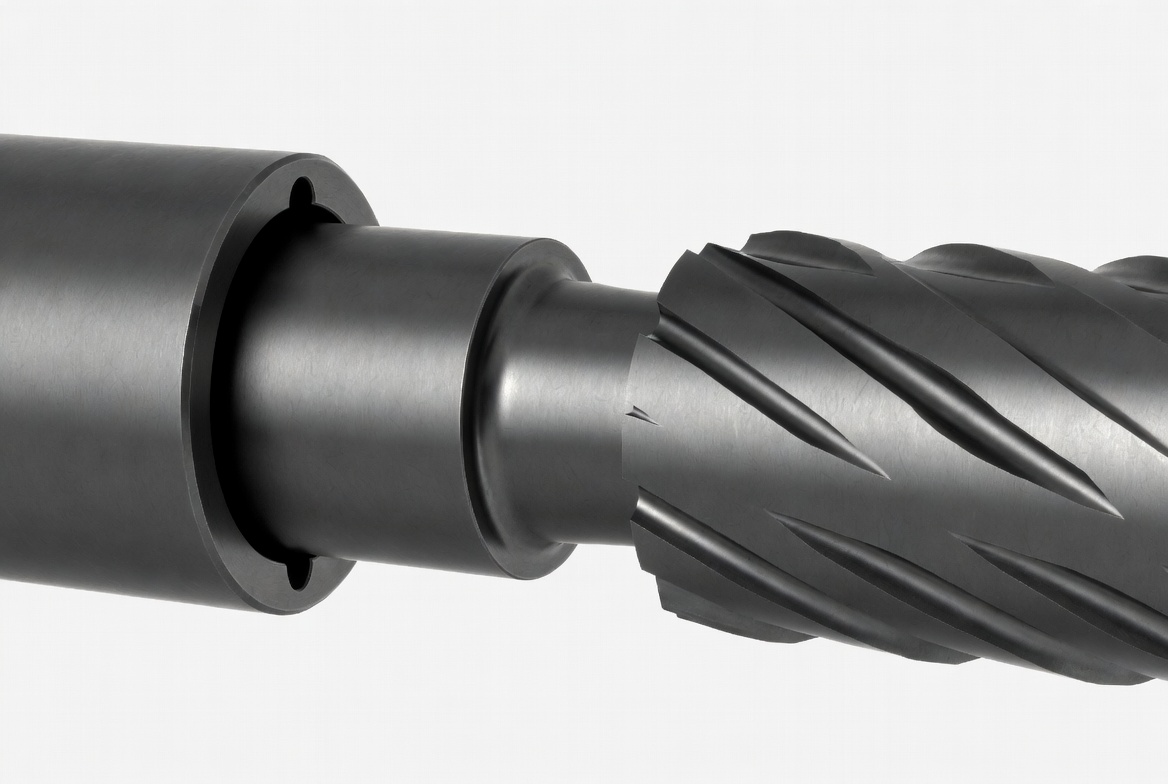
To visualize this part, you need to follow the path of a chambered cartridge:
- The body of the case fits into the chamber.
- The collar is positioned in the corresponding part.
- The projectile extends beyond the casing and is oriented towards the bore.
- In front of it, there may be a short cylindrical section without rifling: the The term "freebore" in English refers to the smooth, unrifled section of a gun barrel just ahead of the chamber. It is the portion of the barrel before the rifling begins, allowing the bullet to travel a short distance before engaging the rifling grooves..
- After this zone begins the transition to the stripes. The peaks of the stripes gradually develop at a determined angle: this is the scratch marks in the strict sense.
- The projectile then enters the fully formed rifling, followed by the rest of the bore.
The length and geometry of each of these zones depend on the caliber, the chamber design, the chosen standard, the intended use of the firearm, the projectile considered, and the choices of the manufacturer or gunsmith. Standardized cartridge and chamber drawings represent these dimensions to ensure safety, reliability, and interchangeability.
Here is the translation of your text from French to English: Difference between freebore, rifling lead, and bullet jump
These notions are often confused even though they correspond to distinct areas or concepts.
The freebore A generally cylindrical portion, without rifling, located just in front of the chamber. The projectile can advance there before encountering the beginning of the rifling. Its length contributes to the distance the projectile must travel before being engraved. The SAAMI defines it as a part whose diameter is larger than that of the projectile and in which no rifling is present.
The groove cutting cone Inclined transition between the freebore (or the chamber exit) and the fully formed rifling grooves. In this area, the grooves gradually penetrate the surface of the projectile.
The bullet jump (projectile jump) Distance that the bullet must travel before engaging the rifling. This distance does not depend solely on the freebore. It also depends on the geometry of the projectile, its seating depth, the actual length of the cartridge, the shape of its bullet, the dimensions of the chamber, and the wear condition of the rifling engagement.
Two projectiles assembled to the same overall length can have a different distance to the rifling if their bullets do not have the same shape.
Why is the overall length of the cartridge (COAL / OAL) not sufficient ?
The overall length is measured from the base to the tip of the projectile. It is essential for verifying compatibility with the magazine, feeding, compliance with certain specifications, and the general size. However, it does not precisely describe the relationship between the bullet and the rifling.
The tips may show slight variations. Two projectiles of the same reference can have a slightly different total length while positioning their ogive very close to each other. Conversely, two projectiles with the same total length but different shapes can engage the rifling at very different positions.
That is why studies concerning the depth of penetration often use a measurement between the base and a reference area of the bullet (CBTO) rather than the total length up to the tip. Berger points out that the actual relationship with the rifling depends on the bullet and recommends basing comparisons on this reference.
Mechanical role of the threading grip
The projectile cannot pass directly from free space to fully formed rifling without a transition. The cone allows for a gradual entry. At the moment the projectile reaches it:
- Its casing meets the contours of the barrel.
- its surface is beginning to deform
- The stripes gradually appear.
- The projectile is centered in the core.
- The rotation begins.
- the resistance to progress increases
This transition must be sufficiently smooth to guide the projectile without causing excessive asymmetric deformation. A properly made grip contributes to centered, gradual, reproducible penetration that is compatible with the expected pressure. While it does not guarantee accuracy on its own, it is one of the first surfaces of the barrel capable of directly influencing the projectile after it leaves the case.
Why must the rifling grooves engrave the projectile ?
The grooves give the projectile its spin, which ensures its gyroscopic stability. The lands slightly penetrate the jacket; the grooves form the spaces into which some of the material can move. The projectile comes out with characteristic marks.
This operation requires a force. The resistance depends notably on the diameter of the projectile, the actual diameter of the bore, the material of the jacket, the length of the bearing surface, the profile, the number and depth of the grooves, the surface condition, and the angle of the rifling engagement. When the projectile reaches the rifling, this resistance contributes to the evolution of the internal pressure.
Link between scratching and pressure
The pressure begins to increase as soon as the charge ignites. It acts on the base of the projectile and tries to push it forward. As long as the projectile has not advanced sufficiently, the available volume behind it remains small. When it encounters the rifling, it must overcome the resistance required for engraving and for setting it into rotation.
If the projectile is already in contact with the rifling at the moment of ignition, its movement immediately encounters this resistance. If it has a jump, it begins to move before reaching the rifling. Berger indicates that a projectile placed in contact immediately encounters engraving force and that this configuration can produce a significantly higher pressure than a projectile positioned slightly back.
This does not mean that a significant jump is always preferable. It means that the depth of seating and the distance to the rifling are among the parameters that can affect the behavior of a load. Ammunition developed with a projectile positioned away from the rifling should not be modified to place it abruptly in contact without completely redoing the loading process with reliable data.
Can the projectile be in direct contact with the rifling ?
In certain precision shooting and specialized reloading practices, shooters work with a projectile that is slightly seated back, touching, or sometimes slightly engaged in the rifling. These configurations require precise knowledge of the chamber, the projectile, the ammunition, and the pressure. They also involve practical constraints: an engaged projectile can become stuck during the extraction of an unfired cartridge; the case can separate from the projectile and spill powder into the mechanism. Berger explicitly highlights this risk.
For a hunting weapon, service rifle, or any carbine requiring perfectly reliable feeding and extraction, this consideration is essential. The pursuit of accuracy must never compromise safety, the feeding, the extraction of an intact cartridge, compatibility with the magazine, and the necessary margin to account for temperature variations and fouling.
Does a short distance to the scratches always improve accuracy ?
No. There is no universal distance that consistently produces the best groupings. Some weapon-projectile combinations yield good results close to the rifling; others work better with a greater jump. Sensitivity varies depending on the shape of the bullet, the length of the bearing surface, the actual diameter of the projectile, the chamber, the barrel, the velocity, the charge, the rigidity of the assembly, and the consistency of the projectile.
Berger indicates that some rifles achieve their best accuracy with the projectile very close to the rifling, while others work better with a significantly larger jump. The seating depth should be considered as a variable to test, not as a single rule. The shooter must distinguish between a better single grouping and a true reproducible trend obtained under comparable conditions and reliable enough for their use. A few shots are not enough to establish a general rule.
Importance of the shape of the ogive
The ogive is the curved part of the projectile located between its bearing surface and its tip. Its shape determines the point where it meets the rifling engagement cone. Two projectiles of the same caliber can have a tangent ogive, secant ogive, hybrid ogive, a bearing surface that is more or less long, or a reference diameter reached sooner or later.
A projectile with a tangent ogive generally has a smoother transition. A projectile with a secant ogive can offer good aerodynamic performance but tends to be more sensitive to its position. Hybrid projectiles combine several profiles in order to find a compromise. Berger explains that their hybrid profiles combine a tangent section and a secant section to reduce sensitivity to the distance from the rifling grooves compared to certain traditional VLD profiles.
The relationship between the projectile and the rifling impression must therefore be analyzed with the exact reference of the projectile used. A measurement obtained with one model cannot be automatically applied to another.
What is projectile engraving ?
Engraving corresponds to the impression of the lands of the barrel into the surface of the projectile. When the projectile enters the rifling grooves, the raised areas begin to mark its casing. This operation centers the projectile, imposes its rotation, locally deforms its casing, creates initial resistance, and prepares its passage through the rifled bore.
A regular engraving must occur symmetrically. If the transition area shows a significant defect, irregular wear, or asymmetrical deposits, the engagement can become less uniform. This irregularity can theoretically influence the initial alignment, deformation of the jacket, starting resistance, velocity, and dispersion. However, it is difficult to attribute poor grouping solely to the rifling engagement without thorough inspection and testing.
Wear and erosion of the throat
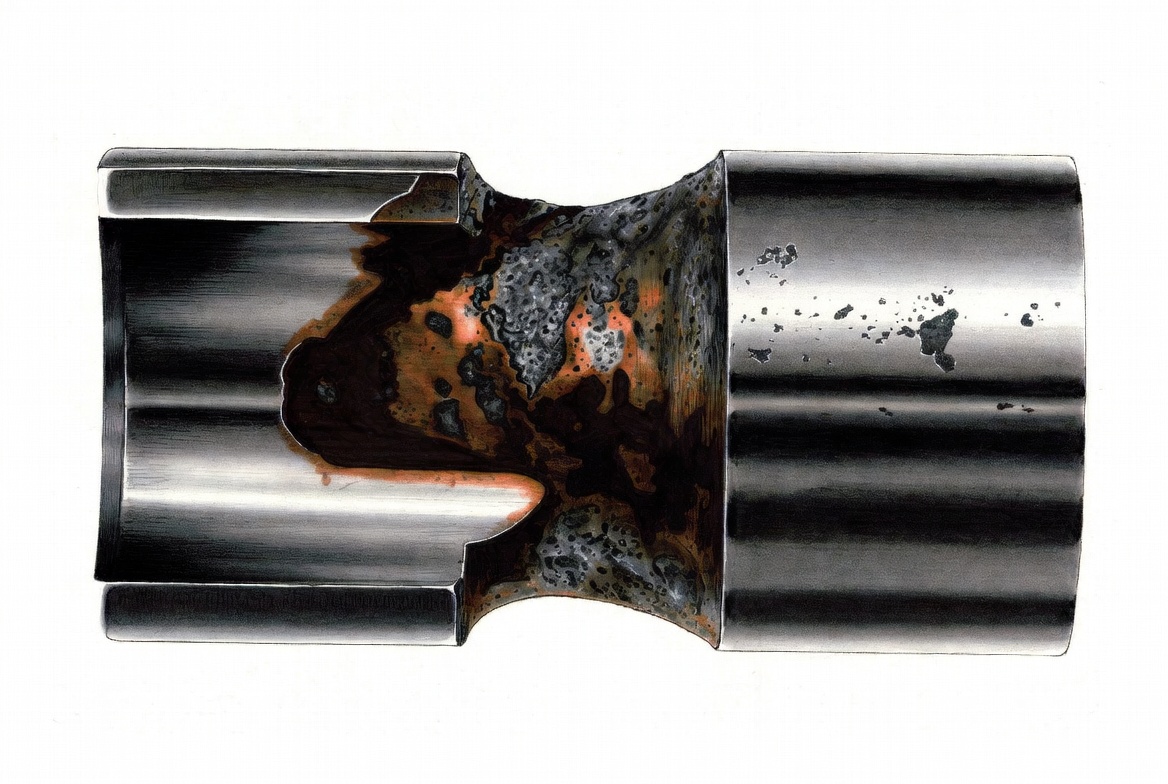
The rifling is exposed to particularly severe conditions: very hot gases, high pressure, combustion particles, projectile passage, repeated thermal cycles, and mechanical stresses. It is located in the immediate vicinity of the chamber, where the gases reach high temperatures and pressures. With each shot, the surface undergoes a combination of thermal erosion, chemical erosion, mechanical wear, expansion, and cooling.
This repetition can gradually modify the surface condition, the transition angle, the sharpness of the beginning of the grooves, the effective length of the throat, and the distance between the projectile and the grooves.
The erosion of the throat It corresponds to the progressive degradation of the area located in front of the chamber. At the beginning, the entrance of the rifling is clear and regular. With use, it can become rougher, slightly cracked, less defined, more advanced into the barrel, or covered with stubborn deposits. The erosion does not necessarily resemble a broken groove or a spectacular cavity. It can take the form of a network of small alterations visible only with an endoscope. The rifling engagement then appears to have receded: in reality, the material at its entrance has been progressively attacked. The projectile must travel a greater distance before encountering a part of the rifling that is still sufficiently marked.
Factors accelerating erosion
- Amount of powder burned
- Relationship between case capacity and barrel diameter (high-capacity cartridges for small-diameter projectiles)
- Pressure
- Temperature
- Rate of fire and length of bursts
- Type of powder (reactivity, quantity, combustion temperature)
- Barrel material (composition, treatment, manufacturing quality)
- Maintenance (improper cleaning or accumulated deposits left behind)
It is impossible to give a universal number of shots corresponding to the lifespan of a barrel. Two identical barrels using the same caliber can wear differently depending on their usage.
Rate of fire vs number of shots The total number of shots remains a useful indicator, but it does not tell the whole story. A barrel used slowly, with cooling phases, does not undergo the same thermal cycle as a barrel used in rapid series. When the temperature rises significantly, thermal stresses accumulate, the surface of the throat remains exposed to hot gases, and subsequent shots occur in an already heated barrel. It is not necessary to wait for the barrel to be completely cool after each shot, but it is important to avoid unnecessarily maintaining an excessive temperature, especially with fast calibers or during long series.
Stainless steel Stainless steel can offer advantages in terms of corrosion resistance and machinability. This does not mean that it is invulnerable to throat erosion. Hot gases, pressure, and thermal cycles continue to have an effect. The lifespan depends more on the steel grade, metallurgical quality, treatment, finish, geometry, gauge, rate of fire, and maintenance. A quality carbon steel barrel can maintain excellent performance for a long time; a stainless steel barrel can wear out quickly in a very demanding setup.
Chrome and surface treatments Some firearms have a chrome-lined bore or undergo treatments designed to improve corrosion resistance, wear resistance, ease of maintenance, or durability. These treatments can enhance overall resistance and affect the finish and internal tolerances. A firearm intended for intensive military shooting does not have exactly the same priorities as a precision rifle. No treatment completely eliminates erosion; it can only alter its rate and consequences.
How does wear cause scratches to "recede" ?
The grooves do not physically move. The part closest to the chamber erodes. Their sharp beginning therefore gradually shifts further away. For a given projectile and a measurement made using the same method, the length required to reach the grooves can increase. The shooter who regularly measures the contact position can observe this change. However, this measurement must be interpreted with caution: it can vary depending on the projectile, tool wear, applied force, fouling, temperature, variations in the bullet, and the way the firing pin or ejector acts on the measuring cartridge. A single measurement is not sufficient; a reproducible trend must be sought.
Does wear immediately destroy precision ?
No. A rifle can continue to produce excellent groupings even when its rifling shows signs of erosion. Precision does not disappear after an exact number of shots. It can change gradually. The shooter may observe several phases: a new barrel requiring a stabilization period, regular functioning, progressive fouling buildup, increased sensitivity to certain loads, greater dispersion, and persistent loss of consistency.
In some cases, adjusting the ammunition can help regain some of the accuracy. In others, the barrel no longer produces the desired results. The limit also depends on the use: a barrel that has become insufficient for a very high-level competition can still be perfectly suitable for training, recreational shooting, certain disciplines, or hunting at reasonable distances.
Why can a worn groove socket modify the groupings ?
Several mechanisms can be involved:
- greater distance from the scratches
- less regular entry (rougher or less symmetrical surface)
- accumulation of deposits (copper and residues accumulating more in the altered zones)
- variation of resistance (force required for less smooth rotation)
- increased sensitivity to the projectile (some profiles tolerate the progression better)
- modification of the vibratory regime (variation of pressure or velocity altering the dynamic behavior of the barrel)
These effects remain linked. It is rarely possible to perfectly isolate a single factor under the usual conditions of a test bench.
Other practical aspects
Why do some cannons seem to become better after several shots ? A new barrel has a surface resulting from its manufacturing (fine tool marks, initial roughness, particularly sharp edges, tendency to retain more copper). After several shots and proper maintenance, some asperities may stabilize. Fouling becomes more predictable. This phenomenon should not be interpreted as an obligation to fire a precise number of cartridges according to a universal ritual. Break-in procedures vary depending on the manufacturers and gunsmiths. The owner must follow the recommendations that correspond exactly to their barrel.
Can cleaning damage the socket with scratches ? Yes, when it is done with inappropriate equipment or a poor method (rod rubbing against surfaces, poorly fitting guide, overly aggressive brush, tool inserted at an angle, abrasive used incorrectly, repeated disassembly without necessity, attempt at mechanical scraping). The risk of scratches is generally better protected when cleaning is done from the chamber with a suitable guide. However, not all firearms allow this method. Cleaning must respect the design of the firearm, the manufacturer's recommendations, the nature of the products, the materials involved, and the actual level of fouling. A barrel should not be aggressively treated just to systematically obtain a perfectly white patch. Insufficient cleaning can leave problematic deposits; excessive or harsh cleaning can cause damage.
Copper deposits near the scratch mark The initial engraving can promote the deposition of material in the first few centimeters. A rough area generally retains deposits more easily. These deposits can in turn alter the local diameter, friction, regularity, and ease of cleaning. Visible discoloration or deposits alone do not allow for a diagnosis of severe wear. Inspection must be combined with performance changes and the barrel’s history.
Observation with the naked eye and endoscope In most firearms, the area is difficult to observe directly. An inspection from the muzzle provides a limited perspective; from the chamber, it can be hindered by the receiver, depth, lack of lighting, or viewing angle. An endoscope allows observation of the rifling entrance, deposits, superficial cracks, the general condition, and certain irregularities. However, the endoscope can also cause unnecessary concern: a highly magnified image can turn small normal marks into impressive defects. Interpretation must take into account the magnification, lighting, a reference from a comparable barrel, actual performance, and the number and type of shots fired. An imperfect internal image does not automatically mean that the barrel needs to be replaced.
An endoscopic inspection can reveal a still clear grip, carbon deposits, copper, progressive erosion, small thermal cracks, corrosion, a longitudinal scratch, a localized defect, or a fouled chamber neck. The tool is used to document the condition. It should not replace other checks. A relevant diagnosis compares internal images, groupings, velocities, fouling, the behavior of several rounds, and their evolution over time.
Distinguish normal wear from defect Normal wear appears gradually and corresponds to usage. A defect may show a sudden, asymmetrical, localized development, accompanied by an incident, related to corrosion, resulting from an obstruction, or appearing after an intervention. Signs requiring professional examination include, in particular, a sudden degradation of accuracy, abnormal marks on projectiles or casings, unusual resistance when chambering, a significant variation in velocity, signs of overpressure, suspected obstruction, deep corrosion, visible deformation, or a firing incident. The shooter should not continue testing when a safety issue is possible.
Influence on chambering Chambering mainly depends on the dimensions of the cartridge and the chamber. However, the position of the projectile can create resistance if its ogive reaches the rifling before complete closure (cartridge too long, different projectile, short chamber, deposits in the throat, reloaded ammunition with inappropriate seating depth). Difficult closure should never be forced. Resistance can come from many other causes (improperly resized case, overly advanced shoulder, too thick neck, dirty chamber, insufficiently seated projectile, wrong caliber, foreign object). The cartridge must be removed and examined.
Marks on a chambered projectile When a projectile touches or penetrates the rifling, its bullet tip may show small marks after extraction. Interpretation is delicate: marks can also come from feeding, the magazine, the ramp, extraction, an oblique contact, or deposits. A simple visual observation does not replace measurement. The use of a marker or other makeshift methods can sometimes provide an indication but does not constitute sufficient validation to modify a load.
Deformation before reaching the scratches The projectile is already subjected to several stresses: retention in the neck, extraction force out of the case, gas pressure, possible contact with the chamber exit, movement in the freebore. Its deformation depends on its construction. A projectile with a thin jacket does not behave like a monolithic projectile, a thick-jacketed projectile, a hunting projectile with a bonded core, or a match projectile. The engagement with the rifling must guide these varied designs within the framework provided by the chamber drawing.
Monometallic projectiles Generally made from a copper alloy or a comparable material, they can be longer than a conventional projectile of the same mass (material less dense than lead). Their behavior during engraving can also be different. Manufacturers may incorporate grooves, raised areas, reduced bearing surfaces, or specific profiles. The shooter must follow the data provided by the projectile and powder manufacturer. A seating depth suitable for a conventional jacketed projectile should not be automatically applied.
Variations between weapons of the same caliber Two firearms chambered for the same caliber can exhibit small differences within the limits of the standard. They may also have been produced according to different standards, different reamers, different tolerances, different uses, or different wear histories. A match chamber may seek a particular geometry; a semi-automatic firearm may prioritize more margin for reliability; a hunting firearm must accept a variety of commercial ammunition. One should never assume that ammunition reloaded for one rifle will be suitable for another firearm of the same caliber. Each firearm must be checked separately.
CIP and SAAMI Standards The CIP and SAAMI both pursue objectives of standardization and safety. Their methods, drawings, units, and certain tolerances may differ. A cartridge bearing a similar designation may also pertain to a particular history or standard. The shooter must not mix dimensions from different documents without verifying their compatibility. Standardized drawings serve as the reference for manufacturers, but their technical interpretation requires a good understanding of minimum and maximum limits, diameters, angles, and measurement methods. The presence of a value on a drawing does not constitute sufficient instruction to modify a chamber.
Possible interventions
Can the scratch pickup cone be modified ? Yes, technically, within the scope of gunsmithing work (chambering a barrel, controlled reworking, manufacturing a custom weapon, intervention intended for a specific projectile). This operation requires a suitable reamer, precise machines, alignment control, gauges, a thorough knowledge of the chamber design, and a complete inspection after the intervention. Removing material is irreversible. A mistake can result in incorrect geometry, an overly long chamber, poor alignment, a rough surface, unpredictable pressure or operation, loss of accuracy, or a dangerous weapon. This intervention must be entrusted to a qualified professional.
Can a worn-out scratched socket be restored ? An eroded rifling groove cannot be restored simply by adding material. Depending on the design of the firearm and the condition of the barrel, several professional solutions can be considered: continuing to use the barrel if its performance remains adequate, repositioning the barrel and reworking the chamber in certain mounts, replacing the barrel, or reserving the barrel for less demanding use. On some rifles, a gunsmith can remove a small length from the rear of the barrel, rethread it, and redo the chamber. This operation is only possible if the geometry, threading, profile, markings, components, breech face, and overall condition allow it. It is not a universal solution.
When should a barrel be replaced ? Replacement does not depend solely on its internal appearance. It becomes relevant when accuracy is no longer compatible with use, when degradation is persistent, when several reliable rounds yield the same results, when the optics and mounting have been checked, when supports and technique have been verified, when fouling has been properly addressed, when an inspection confirms advanced wear, or when a safety defect is present. For a competitor, a slight increase in groupings may justify a change. For a recreational shooter, the same barrel can still remain perfectly satisfactory. The main criterion is the match between the remaining performance and the actual use.
Monitoring and diagnosis
Signs that may suggest a progression of the throat condition No single sign is proof. However, several consistent observations may justify an inspection: groups that gradually open up, the need to clean more frequently, larger copper deposits, less consistent velocity, a change in behavior with previously stable ammunition, changes in groove measurements, loss of accuracy when the barrel heats up, first grooves visibly eroded under an endoscope. One must first eliminate the simplest causes (loose mounting screws, faulty optics, stock in contact with the barrel, improperly fixed moderator, uneven supports, change of batch, weather variations, shooter fatigue).
Why is the first centimeter of the barrel so important ? The projectile undergoes its first stressing there: it is aligned, engraved, accelerated, and set into rotation. A variation produced at this moment can continue throughout the rest of its passage through the barrel. However, the barrel functions as a complete system. Accuracy also depends on the quality of the chamber, alignment, bore, muzzle, crown, rigidity, mounting in the receiver, and the ammunition. It would be an exaggeration to present the rifling engagement as the only important area. It is simply one of the most stressed and least visible parts.
Role of the crown in comparison The rifling engagement acts at the beginning of the trajectory. The crown acts at the moment of exit. An irregular crown can allow gases to escape asymmetrically around the projectile. An irregular rifling engagement can influence its initial guidance. Both ends of the barrel are important for different reasons. When a precision problem arises, they should be examined without forgetting the general condition of the bore, the mounting, the ammunition, and the technique.
Long vs short scratch capture Not necessarily one better than the other. A long transition can offer a gradual entry; a shorter transition may correspond to a different chamber design or another use. The result depends on the whole (angle, diameter, freebore length, projectile, pressure, caliber, desired velocity). There is no universally superior geometry. A chamber must be evaluated in relation to the purpose for which it was designed.
Why do some chambers have a large freebore ? A longer freebore can be chosen to accommodate long projectiles, manage a particular geometry, allow for a defined cartridge length, influence the pressure build-up, ensure compatibility with different ammunition, or meet specific requirements. It should not be concluded that a long freebore automatically results in poor accuracy. Some extremely precise firearms use geometries with a significant jump. The quality depends on the consistency between the chamber, the projectile, and the ammunition.
Does the charger limit the distance to scratches ? Yes. Even when a chamber allows placing a projectile very far forward, the cartridge often needs to fit in the magazine. It must also present itself correctly, feed under the lips, enter the chamber, and be extracted intact. Berger points out that the maximum length compatible with the magazine can prevent using a position close to the rifling, especially with long projectiles. For a repeating rifle, feeding reliability is an essential requirement. The best grouping achieved by loading each cartridge manually is not necessarily the best setting for actual use.
Temperature and its relationship with scratches Materials expand with temperature. Under normal conditions, these variations remain small, but they add to other parameters. Temperature can especially affect the powder, pressure, velocity, fouling, barrel temperature, and the behavior of the lubricant or residues. Ammunition developed under temperate conditions may behave differently in extreme heat or severe cold. The closer a configuration is to its limits, the less margin it retains. This additional reason explains why ammunition intended for hunting or operational use must prioritize robust reliability.
Presence of a sound moderator The suppressor does not directly alter the geometry located in front of the chamber. However, it can modify the overall functioning of certain firearms by affecting the residual pressure, the cycle of a semi-automatic weapon, temperature, fouling, and gas return. Hornady points out that the duration of pressure and the pressure available at the gas system can influence the cycling of semi-automatic firearms, particularly depending on the barrel length, the gas system, and the presence of a suppressor. A firearm frequently used with a suppressor may therefore exhibit different fouling. This does not mean that the suppressor directly causes throat erosion, but it contributes to the overall conditions of use.
How to monitor the wear of a barrel The shooter can keep a notebook containing the approximate number of shots, types of ammunition, batches used, charges employed (within a legal framework for reloading), usual rate of fire, cleanings, reference groupings, average velocities, endoscopic inspections, and rifling measurements carried out using the same method. This tracking allows distinguishing a poor single session, a batch change, a mounting problem, or a lasting trend. It is preferable to compare results obtained under conditions as similar as possible.
Why not change the ammunition after just one poor grouping? A poor grouping can result from many factors. Before adjusting the seating depth, it is necessary to check the stability of the position, wind conditions, barrel temperature, the tightening of the optics, the consistency of the supports, the condition of the chamber, the batch of ammunition, and the presence of any obvious defect. Changing several parameters simultaneously prevents understanding the cause. The shooter risks moving the projectile towards the rifling when the problem actually comes from a loose mounting. This adjustment can then introduce an additional risk without solving the initial issue.
The most common mistakes
- Confusing freebore and rifling engagement
- Thinking that the projectile must always hit the rifling grooves
- Copy the length of another carbine.
- Use only the total length
- Modify the indentation without reloading.
- Forcing a cartridge that chambers poorly
- Judging the cannon solely with an endoscope
- Clean aggressively
- Confusing erosion and corrosion
- Replace the barrel based on a theoretical figure.
Atlas Defense Method: Diagnosing a Progressive Loss of Accuracy
- Check the shooter (compare the results with another competent shooter when possible).
- Check the optics (rings, base, rail, and the functioning of the scope).
- Check the fastening of the bolt (tightening according to the manufacturer's recommendations).
- Check the barrel clearance (look for unwanted contact with the stock when the mount is designed to be free-floating).
- Control the mouth (crown and assembly of a possible accessory).
- Test a reference ammunition (known for its reliable functioning in the firearm).
- Observe the cases (look for unusual signs without drawing conclusions from a single clue).
- Clean properly (remove deposits using an appropriate method, without damaging the barrel).
- Measure performance (sufficiently representative groupings and, if possible, speeds).
- Have the throat examined (professional inspection or endoscopic examination when simple causes have been ruled out).
FAQ
What is the thread engagement cone ? Transition zone located in front of the chamber, where the rifling gradually appears and begins to engrave the projectile.
The difference between the freebore and the throat in a firearm barrel is as follows: - **Freebore**: This is the smooth, unrifled section of the barrel just ahead of the chamber. It allows the bullet to travel a short distance before engaging the rifling grooves. The freebore helps reduce pressure and can influence accuracy and velocity. - **Throat**: This is the area immediately after the freebore where the rifling begins. It is the transition zone where the bullet starts to engage the rifling grooves. The throat can experience significant wear due to the hot gases and bullet friction. In summary, the freebore is the initial smooth section after the chamber, and the throat is the rifled section that follows, where the bullet starts to spin. ? The freebore is a cylindrical portion without rifling. The throat includes the area associated with the chamber entrance and the transition to the rifling.
What is the bullet jump ? Distance traveled by the projectile before its warhead encounters the rifling.
Does the projectile need to engage the rifling to be accurate ? No. Some weapons work well close to the grooves; others give better results with a larger jump.
Why can contact with scratches increase pressure ? Because the projectile immediately encounters the resistance necessary for its engraving and rotation.
Does the overall length of the cartridge indicate its distance to the rifling ? Not exactly. The shape of the ogive and its variations influence the actual point of contact.
Why use a measurement of the cartridge base to the ogive ? It allows for a more direct comparison of the position of the part of the projectile that meets the rifling.
What is throat erosion ? Progressive degradation of the area located in front of the chamber due to hot gases, pressure, thermal cycles, and the passage of projectiles.
Which calibers wear out the rifling the fastest ? Cartridges burning a large amount of powder behind a small-diameter projectile are often more demanding, but the actual lifespan also depends on the rate of fire and the barrel.
Does the rate of fire affect wear and tear ? Yes. Rapid firing keeps the barrel at a high temperature and can accelerate wear.
Can erosion be seen with the naked eye ? It is generally difficult to observe without an endoscope or appropriate equipment.
Does a worn throat mean that the barrel is unusable ? No. The barrel can remain sufficiently accurate for its use despite visible erosion.
What signs can indicate wear ? Progressive opening of groupings, faster fouling, different sensitivity to ammunition, or measurable changes in the position of the rifling can justify an inspection.
Can cleaning damage the surface by causing scratches ? Yes, if a stick, a brush, or an abrasive is used incorrectly.
Can the scratch pickup cone be remade ? In certain configurations, a gunsmith can rework the chamber or reposition the barrel. This intervention is neither simple nor universal.
Should a barrel be replaced as soon as the rifling wears down ? No. The replacement depends on the desired performance and the overall condition of the barrel.
Does a match chamber necessarily have a short freebore ? No. The geometry depends on the projectile and the intended use for which the chamber was designed.
Can a cartridge that is too long prevent it from closing ? Yes. Its projectile can encounter the rifling before the bolt is fully closed.
Can the bolt be forced when the projectile touches the rifling ? No. Any abnormal resistance should lead to removing and inspecting the cartridge.
Who can modify a scratch mark ? This operation must be entrusted to a gunsmith or a professional skilled in chambering, tolerances, and safety checks.
Conclusion
The rifling engagement cone is a tiny area on the scale of a barrel. Yet its influence is considerable. It is at this point that the projectile leaves the space in front of the chamber, gradually encounters the rifling, begins to deform, and receives its rotation.
This transition directly affects the initial resistance to movement, the pressure build-up, guidance, consistency, sensitivity to the depth of insertion, and the wear of the barrel with use.
The freebore, the rifling engagement, and the bullet jump must be distinguished. The freebore corresponds to the smooth portion without rifling located in front of the chamber. The rifling engagement constitutes the conical transition. The bullet jump refers to the actual distance separating the bullet tip from the beginning of the rifling. This distance depends on the chamber, the geometry of the projectile, and its position in the case. It cannot be accurately deduced from the overall length of the cartridge alone.
The shooter must also keep in mind that a projectile close to the rifling is not automatically more accurate. Each assembly formed by the barrel, the chamber, the projectile, and the cartridge has its own behavior. A contact position can increase pressure and reduce the operating margin. It can also make the extraction of an intact cartridge more difficult. Reliability must remain a priority, especially for a hunting, service, or repeating firearm.
Over time, the rifling wears down. Hot gases, pressure, temperature, and the passage of projectiles gradually alter its condition. This deterioration does not immediately render the barrel unusable. It must be assessed based on grouping, velocities, fouling, history, and a proper inspection.
The replacement of a barrel should never be decided solely based on the spectacular appearance of an endoscopic image. Conversely, a lasting loss of precision should not be ignored when other causes have been ruled out.
The proper approach is to observe, measure, compare, and have the weapon inspected by a professional when doubt persists.
These few invisible millimeters thus summarize a large part of the complexity of interior ballistics. They show that between the chamber and the rifling, no detail is truly insignificant.