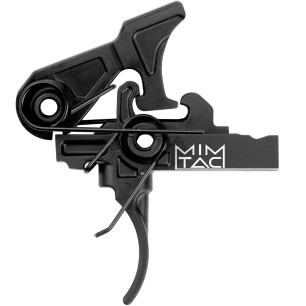
What relaxation! MIMTAC Which one to choose for your AR-15, AR-10, AR-9, or Derya MK-12 ?
Trigger pull is one of the factors that influence the shooting experience. It does not mechanically transform an average firearm into a precision rifle, but it can allow the shooter to more effectively utilize the potential of their weapon.
A cleaner stroke, a more easily identifiable hard point, a crisper break, and a shorter reset make it easier to control the trigger pull. Conversely, a poorly chosen trigger pull can become uncomfortable, unsuitable for the discipline practiced, or incompatible with the operation of the firearm.
There is therefore no universally better trigger than all others. A very direct and fast trigger can be excellent for dynamic shooting, but less intuitive for a shooter seeking a progressive release. A two-stage trigger can provide a lot of control at medium distance, while being less instinctive during very fast sequences.
The range MIMTAC proposed by Atlas Defense allows to meet several uses:
-
precision shooting with an AR-10 ;
-
Mini Rifle in .22 LR ;
-
versatile shooting with multiple calibers ;
-
TSV Shotgun with a Derya MK-12 or a compatible AR-12 platform.
In this guide, we will compare the six relaxations. MIMTAC Currently offered by Atlas Defense, explain their differences and determine which one to choose based on the weapon, caliber, shooter's skill level, and the discipline practiced.
Why replace the original trigger of an AR ?
Most entry-level or mid-range AR platforms are equipped with a military-type trigger group, generally designed to prioritize simplicity, durability, and operational safety.
This type of relaxation can be perfectly suitable for recreational use. However, it often has several noticeable characteristics:
-
a relatively long race ;
-
a high starting weight ;
-
a scratching before the break ;
-
a starting point difficult to anticipate ;
-
a somewhat unclear break ;
-
a long or barely noticeable reset.
These characteristics do not make the weapon unusable. However, they can complicate the shooter's work when seeking greater precision or speed.
A trigger release primarily aims to improve the consistency of the shot release. It allows the shooter to apply pressure more steadily and to limit involuntary movements transmitted to the weapon at the moment of firing.
Replacement can be particularly relevant in the following configurations:
-
AR-15 equipped with a scope or an LPVO ;
-
AR-10 intended for medium-range shooting ;
-
AR-9 used in TSV PCC ;
-
.22 LR carbine of the Mini Rifle type ;
-
AR-15 used in dynamic shooting ;
-
Derya MK-12 prepared for the TSV Shotgun.
The choice must, however, remain consistent with the actual use of the weapon. An extremely fast trigger pull is not automatically preferable for all shooters.
Single-stage or two-stage : what difference ?
Before comparing the models MIMTAC, It is essential to understand the difference between a single-stage expansion and a two-stage expansion.
Single-stage expansion
A single-stage trigger, or single-action trigger, has a very short deliberate travel before breaking.
When the shooter applies pressure, they quickly reach the necessary weight to fire. The sensation is direct and generally very crisp.
This architecture is particularly appreciated in dynamic shooting, as it promotes:
-
quick departures ;
-
the doubles ;
-
transitions between multiple targets ;
-
the immediate recovery after the decline ;
-
high-speed sequences.
It nevertheless requires good discipline of the index finger. The shooter must strictly adhere to safety rules and only place their finger on the trigger when the weapon is pointed at the target and the decision to shoot has been made.
The two-stage expansion
A two-stage expansion, or two-step expansion, divides the movement into two phases.
The first stage is a deliberate, light, and controlled pull. The shooter can gradually absorb it until reaching a clearly identifiable point of resistance, often called the wall.
Additional pressure then causes the rupture.
This architecture is highly appreciated for:
-
precision shooting ;
-
prone shooting or supported shooting ;
-
distant targets ;
-
the small scoring areas ;
-
DMR configurations ;
-
The AR-10 chambered in .308 Winchester.
The two-stage trigger allows the shooter to prepare for the shot without firing immediately. It provides the shooter with an additional tactile reference, particularly useful when the release must be perfectly synchronized with the stability of the weapon.
Which architecture should be chosen ?
To simplify:
-
The single-stage generally favors speed and simplicity ;
-
The two-stage generally favors control and preparation of the start.
This is not an absolute rule. Some precision shooters prefer a single-stage trigger, while some dynamic shooting competitors use a two-stage trigger. The choice also depends on each person's experience, habits, and sensitivity.
Comparative Table of Expansions MIMTAC
| Model | Architecture | Announced weight | Main platforms | Recommended use |
|---|---|---|---|---|
| MIMTAC Phase II | Two-stage | About 1.36 kg | AR-15 and AR-10 mil-spec | Precision, DMR, medium range |
| MIMTAC Drastic Gen 2 | Single-stage | 1.45 kg | AR in .22 LR, 9 × 19, 5.56, .223, .300 BLK, and .308 | Versatility, TSV Rifle, PCC |
| MIMTAC Drastic AR-9 | Single-stage | 1.58 kg | AR-9 | TSV PCC, dynamic shooting 9 mm |
| MIMTAC Drastic AR-10/AR-15 | Single-stage | 1.58 kg | AR-15 and AR-10 | Leisure, progression, versatility |
| MIMTAC Drastic ST | Single-stage | 1.58 kg | Derya MK-12 and AR-12 compatible | TSV Shotgun |
| MIMTAC Valkyrie | Single-stage | 1.36 kg | AR-15 and AR-10 | Speed, TSV Rifle, Mini Rifle |
The announced features and compatibilities correspond to the information available in the Atlas Defense category at the time of writing. The range currently includes six references.
MIMTAC Phase II : the best option for accuracy
A two-stage trigger for AR-15 and AR-10
The MIMTAC Phase II stands out immediately from the other models in this selection. It is the only two-stage trigger in the compared range.
It is designed for AR-15 and AR-10 platforms to mil-spec specifications. Its total announced weight is approximately 1.36 kg, distributed between the two stages of the trigger.
The first phase allows the shooter to gradually get in touch with the mechanism. Once the wall is reached, additional pressure triggers the shot.
This separation of phases provides excellent clarity from the start.
For which weapons should you choose Phase II ?
Phase II is particularly consistent in:
-
an AR-15 in .223 Remington or 5.56 × 45 ;
-
an AR-15 in .300 AAC Blackout oriented towards precision ;
-
an AR-10 in .308 Winchester ;
-
a DMR configuration ;
-
a rifle equipped with an LPVO ;
-
a rifle equipped with a high-magnification scope ;
-
a weapon used mainly between 100 and 300 meters.
On an AR-10, the two-stage trigger allows the shooter to prepare the shot while keeping the weapon properly positioned on the shoulder. The shooter can take up the first stage while stabilizing their aim, then release the trigger at the desired moment.
For which disciplines ?
Precision shooting with support
This is the most natural use of Phase II. The wall allows for better anticipation of the start and helps to limit finger slips.
Mid-range shooting
On a target located at 100, 200, or 300 meters, an irregular pressure on the trigger can be enough to degrade the grouping. Phase II helps to reproduce a more consistent trigger release.
DMR-type shooting
For a versatile semi-automatic rifle, capable of engaging both close and distant targets, the Phase II offers a good balance between tactile safety, control, and speed.
Dynamic shooting with distant targets
It can also be used in TSV Rifle when the courses include small targets, partially hidden targets, or longer-distance engagements.
However, it will be a little less immediate than a Valkyrie on sequences exclusively focused on speed.
To which shooter is it addressed ?
Phase II will be particularly suitable for the shooter who:
-
likes to gradually prepare their departure ;
-
search for a clearly perceptible wall ;
-
mainly works on precision ;
-
use a scope or an LPVO ;
-
wants to better analyze his/her release ;
-
Find a single-stage release that is too direct.
Verdict on the MIMTAC Phase II
Phase II is the recommended priority for a precision AR-10, an AR-15 DMR, or a carbine primarily used on support.
It offers the best starting reading among the six models presented.
MIMTAC Drastic Gen 2 : the most versatile
A single trigger for multiple platforms
The Drastic Gen 2 is probably the most versatile model in the range. MIMTAC.
This is a single-stage trigger announced at 1.45 kg, with a straight pull backward and optimized reset.
Its announced compatibility covers several platforms and calibers:
-
AR in .22 LR ;
-
AR-9 in 9 × 19 mm ;
-
AR-15 in 5.56 × 45 ;
-
AR-15 in .223 Remington ;
-
AR in .300 AAC Blackout ;
-
AR-10 in .308 Winchester.
This wide compatibility makes it an interesting solution for the shooter who has multiple setups or wishes to maintain a similar trigger feel across different firearms. For which weapons should you choose the Drastic Gen 2 ?
It can be installed in many configurations:
-
Versatile AR-15 ;
-
Competition AR-9 ;
-
AR-10 oriented towards dynamic shooting ;
-
AR in .300 Blackout ;
-
AR in .22 LR ;
-
Lower used with several upper receivers.
It is particularly relevant when a weapon must be used for several types of sessions: occasional precision, gong shooting, timed drills, and competition.
For which disciplines ?
TSV Rifle
The Drastic Gen 2 offers a sufficiently light start to facilitate quick shots, without being as direct as the Valkyrie.
It represents an excellent compromise for a shooter who participates in varied courses, including both close targets and engagements requiring more control.
TSV PCC
Its announced compatibility with the AR-9 makes it interesting for 9 × 19 mm carbines used in PCCs.
The short reset facilitates successive shots and quick transitions.
The IPSC PCC rules notably distinguish between the Optics and Iron divisions. They allow several pistol calibers, including 9 × 19 mm, and do not impose a general restriction on the type of action. However, the shooter must ensure that all their equipment complies with the division they are competing in. Dynamic recreational shooting
For training on gongs, position changes, and timed sequences, the Gen 2 provides a crisper feel than a classic mil-spec trigger group.
Multicaliber configuration
This is probably its main advantage. A shooter using the same lower receiver with multiple upper receivers can maintain a familiar trigger.
To which shooter is it addressed ?
The Drastic Gen 2 is ideal for those who:
-
seeking a unique and versatile relaxation ;
-
practices several forms of shooting ;
-
owns several AR platforms ;
-
hesitates between precision and speed ;
-
wants a relaxed match without choosing a model that is too specialized.
Verdict on the Drastic Gen 2
For a customer who does not yet know which trigger to choose or who wants to equip a versatile weapon, the Drastic Gen 2 is the most rational recommendation.
She is not necessarily the best in any one specialty, but she is probably the most well-rounded in all situations.
MIMTAC Drastic AR-9 : the PCC specialist
A mount dedicated to AR-9 platforms
The Drastic AR-9 is a single-stage trigger preset to 1.58 kg.
It is specifically advertised for AR-9 platforms and is therefore intended for shooters using a pistol-caliber carbine, primarily in 9 × 19 mm.
Like the other Drastic models, it offers a straight pull to the rear, optimized reset, and supplied anti-walk pins. Why a trigger dedicated to the AR-9 ?
An AR-9 platform may look like an AR-15 on the outside, but its internal operation can be different.
Many AR-9s use an unlocked bolt that operates by simple blowback. The mass of the bolt, the geometry of its lower part, the hammer, the buffer, and the recoil spring can influence the reset of the trigger.
An AR-15 compatible trigger should therefore not automatically be considered compatible with all AR-9s.
The Drastic AR-9 provides a more specialized response here.
For which disciplines ?
TSV PCC
It is particularly suited for courses including:
-
several close targets ;
-
fast doubles ;
-
movements ;
-
changes of position ;
-
timed sequences.
Its weight of 1.58 kg provides a firmer trigger pull than the Drastic Gen 2. Some shooters will appreciate this extra margin, especially when moving quickly or wearing gloves.
Shooting at a gong
The quick reset allows you to chain targets while maintaining a noticeable start.
Intensive training
For a weapon exclusively dedicated to the PCC, a trigger specifically designed for the AR-9 may be preferable to a universal model.
Drastic AR-9 or Drastic Gen 2 ?
The choice can be summarized as follows:
Choose the Drastic AR-9 for:
-
a weapon exclusively used in 9 mm ;
-
a slightly firmer start ;
-
a PCC-oriented use ;
-
A shooter wishing for a dedicated reference.
Choose the Drastic Gen 2 for:
-
look for a slightly lighter start ;
-
use multiple platforms ;
-
install the trigger in a multi-caliber configuration ;
-
prioritize versatility.
Point of caution
Compatibility must always be checked with the exact PCC model.
AR-9 platforms exhibit more mechanical variations than traditional mil-spec AR-15s. A gunsmith inspection is recommended when the firearm manufacturer does not clearly confirm compatibility.
Verdict on the Drastic AR-9
The Drastic AR-9 is the best specialized option in this selection for a carbine used exclusively in PCC, especially when the shooter prefers a slightly firmer trigger pull.
MIMTAC Drastic AR-10/AR-15 : the ideal transition to a relaxing match
A single-stage weighing 1.58 kg
The Drastic designed for AR-10 and AR-15 retains the single-stage architecture of the family.
Its announced weight of 1.58 kg places it between a mil-spec trigger, which is often heavier, and the lightest competition references.
It is announced to be compatible with AR configurations in:
-
.22 LR ;
-
5.56 × 45 ;
-
.223 Remington ;
-
.300 AAC Blackout ;
-
.308 Winchester. For which firearms ?
This Drastic will be particularly suitable for:
-
a recreational AR-15 ;
-
an AR-15 used on a gong ;
-
a versatile AR-10 ;
-
an AR in .300 Blackout ;
-
a compatible .22 LR rifle ;
-
a first weapon preparation.
Why choose a start at 1.58 kg ?
A slightly firmer trigger pull at the start can be interesting for a shooter who does not want to switch immediately from a military trigger to a very light trigger.
This value provides a compromise between:
-
improvement of sharpness ;
-
reduction of effort ;
-
maintaining a perceptible resistance ;
-
versatility ;
-
gradual handling.
It can also be appreciated by shooters who use their weapon in multiple positions, with more dynamic movements than in precision shooting at a table.
For which disciplines ?
Dynamic recreational shooting
It improves the speed of start and reset without becoming excessively sensitive.
Introduction to TSV Rifle
For a beginner shooter in dynamic shooting, it serves as an interesting transition before possibly moving on to a Valkyrie.
Shooting at 50 or 100 meters
Its cleaner break facilitates regular accuracy, even though Phase II remains more specialized for aimed shooting.
Versatile training
It is well suited for a weapon used without the aim of highly specialized competition.
Classic Drastic or Drastic Gen 2 ?
The Drastic Gen 2 is lighter and compatible with more platforms, including the AR-9.
The classic Drastic still holds interest for the shooter who:
-
wants a slightly firmer start ;
-
owns only an AR-15 or an AR-10 ;
-
wants to improve their weapon without aiming for a very fast trigger pull ;
-
discover the match relaxations.
Verdict on the Drastic AR-10/AR-15
The Drastic at 1.58 kg is probably the best entry point in the range. MIMTAC.
It offers a noticeable improvement over many original triggers, while remaining easy to handle.
MIMTAC Drastic ST : the recoil for Derya MK-12 and AR-12
A developed reference for AR-12 type semi-automatic rifles
The Drastic ST is a single-stage trigger preset at 1.58 kg.
It is announced as compatible with:
-
the Derya MK-12 ;
-
compatible AR-12 rifles.
It incorporates the main features of the Drastic family: rearward straight traction, improved control, and optimized reset. For which discipline ?
TSV Shotgun
The Drastic ST is primarily intended for shooters using a Derya MK-12 or a similar semi-automatic rifle in dynamic shooting.
In this discipline, the shooter often has to perform consecutively:
-
several targets ;
-
changes of position ;
-
commitments at different distances ;
-
rapid shots on clay pigeons or gongs ;
-
manipulations and reloadings under time constraints.
A sharper release can help better control the timing of the shot and quickly regain contact after each shot.
Recreational dynamic shooting with a 12-gauge shotgun
Even outside of competition, the Drastic ST can improve the comfort of a rifle whose original trigger feels long, heavy, or irregular.
Are all AR-12 platforms compatible ?
No.
The designation AR-12 refers to a visual and ergonomic family of semi-automatic rifles, but it does not guarantee complete mechanical standardization.
Two rifles resembling an AR-15 can use:
-
different cases ;
-
different axes ;
-
different safety features ;
-
different hammer geometries ;
-
different rearming systems.
Compatibility must therefore be confirmed for each model.
Attention to sports divisions
The presence of the term "Match" or "IPSC" in the commercial name does not automatically guarantee the acceptance of the firearm and all its modifications in each division.
IPSC publishes separate rules for Rifle, Shotgun, Mini Rifle, and PCC. The reference versions were updated as of December 31, 2025, with additional interpretations published in 2026. Competitors must consult the rules corresponding to their discipline and division. Verdict on the Drastic ST
The Drastic ST is the logical choice for a Derya MK-12 or an explicitly compatible AR-12.
It must not be installed in another model based solely on its external resemblance.
MIMTAC Valkyrie : the most speed-oriented
A single-stage direct at 1.36 kg
The Valkyrie is the lightest single-stage trigger in this selection, with a listed weight of 1.36 kg.
It is designed for AR-15 and AR-10 platforms and is characterized by:
-
a direct break ;
-
a reduced voluntary race ;
-
a very short reset ;
-
a straight pull towards the back ;
-
a clearly sporty orientation.
It is announced as compatible with several calibers used on AR platforms, notably the .22 LR, 5.56 × 45, .223 Remington, .300 AAC Blackout, and .308 Winchester. For which weapons ?
The Valkyrie is particularly consistent in:
-
an AR-15 from TSV Rifle ;
-
a Race Gun type rifle ;
-
an AR equipped with a red dot sight ;
-
an AR equipped with an LPVO ;
-
an AR-10 intended for dynamic shooting ;
-
a .22 LR Mini Rifle platform ;
-
a weapon used exclusively in competition.
For which disciplines ?
TSV Rifle
It is probably his/her area of expertise.
The direct start allows reducing the time between the decision to shoot and the break. The short reset facilitates doubles and quick follow-ups.
It is particularly suitable for courses featuring:
-
close targets ;
-
frequent target changes ;
-
unstable positions ;
-
shots on the move ;
-
quick sequences.
Mini Rifle
On a .22 LR platform offering very little recoil, the speed of the reset can be fully exploited.
The Valkyrie allows for maintaining quick movements without waiting for a long reset between strikes.
Shooting at gong and Steel Challenge
Disciplines based on transition speed also benefit from a direct relaxation.
Rapid precision shooting
An experienced shooter can achieve excellent accuracy results with a light single-stage trigger. However, it requires more discipline than a two-stage trigger when the shooter prepares to fire from a rest.
To which shooter is it addressed ?
The Valkyrie will suit the shooter who:
-
already has a good command of the index ;
-
regularly practices dynamic shooting ;
-
seeking an immediate termination ;
-
wants to reduce the time between two shots ;
-
uses their weapon in a specialized sporting context.
When should one avoid such a direct relaxation ?
The Valkyrie is not necessarily the best choice for:
-
a complete beginner shooter ;
-
a weapon primarily used for slow precision ;
-
a user preferring to prepare their departure ;
-
a person finding light triggers uncomfortable ;
-
a setup intended for TAR with a semi-automatic rifle.
Verdict on the Valkyrie
The Valkyrie is the best recommendation in the range for pure speed, the TSV Rifle, and the Mini Rifle, subject to mechanical and regulatory compatibility.
Which trigger should be chosen for the TSV Rifle ?
The TSV Rifle requires a combination of several qualities:
-
execution speed ;
-
weapon control ;
-
quick transitions ;
-
precision on targets of different sizes ;
-
safety during travel.
First choice: MIMTAC Valkyrie
The Valkyrie is best suited for experienced shooters looking for:
-
a direct departure ;
-
a very short reset ;
-
fast doubles ;
-
a strong responsiveness.
Versatile choice: MIMTAC Drastic Gen 2
The Gen 2 will be better suited for the shooter who wants more margin and a weapon that can be used both in competition and for leisure.
Precision choice: MIMTAC Phase II
For routes involving numerous distant or partially obscured targets, Phase II offers superior control.
Atlas Defense Recommendation
-
Valkyrie for speed ;
-
Drastic Gen 2 for versatility ;
-
Phase II for accuracy.
Which trigger should be chosen for the TSV PCC ?
PCC carbines are generally used at short or medium range with rapid sequences.
Top versatile choice: Drastic Gen 2
It offers:
-
a starting weight of 1.45 kg ;
-
a compatibility announced with the AR-9 ;
-
a quick reset ;
-
good versatility.
First specialized choice: Drastic AR-9
It is particularly relevant when installed on a weapon exclusively dedicated to the 9 mm.
Its weight of 1.58 kg can be appreciated by shooters who wish to maintain a more pronounced resistance.
Why not automatically recommend the Valkyrie ?
The displayed compatibility of the Valkyrie mainly concerns the AR-15 and AR-10 platforms. The AR-9 is not explicitly mentioned in the information provided.
It should therefore not be recommended on a PCC without confirmation from the manufacturer or appropriate technical inspection.
Which buffer should I choose for a precision AR-15 ?
First choice: Phase II
Phase II is the most suitable when the main objective is to reduce unwanted movements at the start.
It is particularly consistent with:
-
a telescope ;
-
a bipod ;
-
a prone shot ;
-
a bench table ;
-
distances from 100 to 300 meters.
Alternative: Valkyrie
The Valkyrie will suit the experienced shooter who prefers a direct break and is perfectly capable of managing a light single-stage trigger.
Versatile choice: Drastic Gen 2
For a weapon also used for dynamic shooting, the Gen 2 will be more versatile than the Phase II.
Which buffer should I choose for an AR-10 chambered in .308 Winchester ?
The longer recoil of an AR-10 does not directly determine the choice of trigger. However, the typical intended use of this platform often guides the decision.
For clarity: Phase II
It allows for preparing the shot while stabilizing the weapon.
For dynamic shooting: Valkyrie
It promotes the speed of recovery on multiple targets.
For versatile use: Drastic Gen 2
It represents a compromise between control, speed, and compatibility.
For a first improvement: Drastic at 1.58 kg
It will suit the shooter who wants a crisper trigger pull without immediately going down to 1.36 kg.
Which trigger pull should I choose for a .22 LR AR ?
The .22 LR can be used in several types of platforms:
-
rifle designed directly in .22 LR ;
-
dedicated upper ;
-
conversion kit ;
-
AR replica using a specific mechanism.
These different solutions do not always have the same compatibility with AR-15 triggers.
For the Mini Rifle: Valkyrie
Its short reset and direct start favor speed.
For clarity: Phase II
It allows for practicing release with excellent readability.
For versatility: Drastic Gen 2
It represents the most balanced choice for a weapon used both on target and on gong.
Caution: rearming
Some .22 LR bolt heads or conversions may not properly cock all hammers.
Compatibility must be checked with the manufacturer of the weapon, the trigger group, or the conversion kit.
Can these compensators be used in Target Air Rifle (TAR) ?
The TAR constitutes a special case.
The FFTir TAR 2025-2026 regulations state that the trigger pull weight of shoulder firearms generally cannot be less than 1.360 kg. However, there is an important exception: for semi-automatic rifles, the minimum weight is set at 2 kg. An exemption exists for certain semi-automatic firearms manufactured directly in .22 LR caliber: their minimum weight can be set at 1.360 kg.
On the other hand, a semi-automatic weapon manufactured in a different caliber and equipped with a .22 LR conversion remains subject to a minimum of 2 kg. Consequences for the triggers MIMTAC
The stated weights of the compared models range between 1.36 and 1.58 kg.
On an AR-15 or another centerfire semi-automatic rifle used in TAR, these values are therefore below the minimum of 2 kg specified in the 2025-2026 regulations.
These relaxations should not be presented as TAR-compatible solely based on their commercial weight.
Even for a .22 LR firearm benefiting from the 1.360 kg threshold, several points must be checked:
-
the actual measured weight ;
-
manufacturing tolerance ;
-
the wear of the mechanics ;
-
the repeatability of the start ;
-
the admissibility of the modification ;
-
the overall compliance of the weapon.
A release set exactly at 1.36 kg leaves virtually no margin during inspection.
Atlas Defense recommendation for the TAR
Before any preparation of a weapon intended for TAR:
-
consult the latest version of the FFTir regulations ;
-
precisely identify the test concerned ;
-
check if the weapon is considered an FSA ;
-
measure the actual weight with a suitable instrument ;
-
have the compliance confirmed by an arbitrator or a competent official.
The shooter remains responsible for presenting their weapon for inspection, and the jury may examine the equipment during the competition.
Does a lighter trigger pull automatically make it more accurate ?
No.
A lighter trigger pull reduces the effort needed to fire, which can decrease the movement transmitted to the weapon. But accuracy also depends on many other factors:
-
shooter’s position ;
-
getting started ;
-
stability ;
-
quality of ammunition ;
-
canon ;
-
optics ;
-
breath control ;
-
tracking of the shot ;
-
consistency of the release.
A trigger pull that is too light or too direct for the shooter's level can even worsen the results.
The best choice is therefore not necessarily the model with the lightest weight. It is the one whose operation best matches the discipline and the shooter's preferences.
Flat recoil pad: what are the advantages ?
The six models presented use a straight or flat trigger tail.
This geometry changes the sensation under the index finger compared to a traditional curved tail.
It can provide several advantages:
-
freer placement of the index ;
-
more straight pressure towards the back ;
-
more constant sensation ;
-
better finger position tracking ;
-
Slightly different leverage depending on the contact height.
A support placed lower on a flat tail can give the impression of a lighter start due to the mechanical leverage.
This sensation remains personal. Some shooters always prefer a curved grip, which more naturally guides the index finger towards a central position.
The Importance of Resetting
The reset corresponds to the forward movement necessary for the trigger to be ready to initiate a new shot.
A short reset can improve speed, but only if the shooter knows how to take advantage of it.
After the shot, it is not necessary to completely remove the finger from the trigger. The shooter can gradually release the pressure until they feel or hear the reset, then apply pressure again.
This technique can reduce unnecessary movements of the index finger.
However, it must be practiced in a safe environment. The finger must leave the trigger guard during movements and whenever the shooter is not engaging a target.
The IPSC safety recommendations specifically remind that the index finger must remain outside the trigger guard while moving when no target is engaged.
Installation: Why must the assembly be inspected ?
A drop-in relaxation is designed to simplify installation. This does not mean that the final inspection can be neglected.
After assembly, several checks are essential.
Security control
Hammer cocked and safety engaged, pressing the trigger should never cause the hammer to fall.
After releasing the trigger and disengaging the safety, the hammer must remain cocked.
Disconnector inspection
The trigger must properly hold the hammer when the bolt cycle occurs while the index finger holds the trigger back.
When the trigger is released, the hammer must be properly transferred to the main trigger.
Reset control
The reset must be clear and reproducible.
A lack of reset, an irregular reset, or different operation depending on the position of the weapon requires the immediate cessation of testing.
Axis control
The shafts must remain properly positioned. When anti-rotation or anti-slip pins are provided, they must be installed in accordance with the manufacturer's instructions.
Percussion test
The weapon must produce a sufficiently forceful strike with the ammunition used.
A match trigger can use a hammer or springs different from those of a mil-spec group. Some particularly hard primers may result in insufficient percussion.
Shock control
The unloaded weapon, placed in a safe direction, must retain its cocked hammer during the prescribed mechanical inspections.
No reasonable shock or loosening of the cylinder head should cause the hammer to release.
Selector control
The selector must operate normally, without any abnormal stiffness or possibility of incorrect engagement.
Multiple start control
A single voluntary pull of the trigger must produce a single shot.
Any abnormal behavior, premature release, or double trigger requires the immediate cessation of use and inspection by a gunsmith.
Should you have your trigger installed by a gunsmith ?
A competent person may be able to replace a compatible trigger group. However, the intervention directly involves the firing mechanism.
An installation error can cause:
-
a safety defect ;
-
a poor grip of the hammer ;
-
insufficient percussion ;
-
a faulty reset ;
-
an involuntary departure ;
-
a multiple start ;
-
a deterioration of the parts.
The intervention of a gunsmith is particularly recommended for:
-
the AR-9s ;
-
the non-standardized AR-10s ;
-
the AR-12s ;
-
the Derya MK-12 ;
-
.22 LR conversions ;
-
weapons with specific tolerances ;
-
the configurations intended for competition.
Final ranking of the relaxations MIMTAC
Better relaxation for accuracy
MIMTAC Phase II
Its two-stage operation offers the best control and the clearest wall.
Better relaxation for speed
MIMTAC Valkyrie
Its single-stage trigger pull at 1.36 kg and short reset make it suitable for dynamic shooting.
Best all-around relaxation
MIMTAC Drastic Gen 2
It covers the largest number of platforms, calibers, and uses.
Best buffer for an AR-9
MIMTAC Drastic AR-9
It is specifically announced for this platform.
The Drastic Gen 2, however, is an excellent and more versatile alternative.
Best recoil pad for a Derya MK-12
MIMTAC Drastic ST
This is the only item in this selection explicitly intended for the MK-12 and compatible AR-12s.
Best relaxation to discover a relaxing match
MIMTAC Drastic AR-10/AR-15 at 1.58 kg
Its slightly firmer weight facilitates the transition from a mil-spec trigger.
Quick selection table
| Your weapon | Your use | Recommended model |
|---|---|---|
| AR-15 in .223 or 5.56 | TSV Quick Rifle | Valkyrie |
| Versatile AR-15 | Leisure, precision, and dynamic | Drastic Gen 2 |
| AR-15 with scope | Precision | Phase II |
| AR-10 in .308 | Precision and medium distance | Phase II |
| AR-10 in .308 | Dynamic shooting | Valkyrie or Drastic Gen 2 |
| AR-9 | TSV PCC very versatile | Drastic Gen 2 |
| AR-9 exclusively dedicated to the PCC | Dynamic shooting | Drastic AR-9 |
| AR in .22 LR | Mini Rifle | Valkyrie |
| AR in .22 LR | Precision | Phase II |
| AR in .22 LR | Versatile use | Drastic Gen 2 |
| Derya MK-12 | TSV Shotgun | Drastic ST |
| AR-12 compatible | Dynamic shooting | Drastic ST |
| AR-15 for beginner shooters | First match warm-up | Drastic 1.58 kg |
| FSA intended for the TAR | TAR Competition | No choice without adaptation and regulatory control |
Conclusion: the best relaxation is the one that suits your practice.
The range MIMTAC is not limited to a hierarchy ranging from the least efficient to the most efficient.
Each model follows a different logic.
Phase II favors trigger control. The Valkyrie prioritizes speed. The Drastic Gen 2 seeks the best balance. The Drastic AR-9 meets the requirements of the PCC. The Drastic ST is designed for compatible Derya MK-12 and AR-12 models. The classic Drastic offers a gradual transition to a match-grade trigger.
Before choosing, you must therefore answer four questions:
-
What is the exact platform of the weapon ?
-
What is its caliber and mode of operation ?
-
Which discipline will be practiced ?
-
Does the shooter prefer a direct or gradual start ?
Once these elements are identified, the choice becomes much simpler.
For a precision weapon, the MIMTAC Phase II will generally be the most consistent. For the TSV Rifle or Mini Rifle, the Valkyrie will offer the most dynamic performance. For a versatile weapon or a multi-caliber setup, the Drastic Gen 2 will often be the best compromise.
In all cases, exact compatibility, assembly quality, and safety checks must remain a priority.
Products mentioned in this post