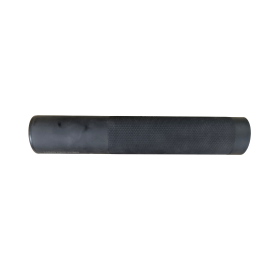
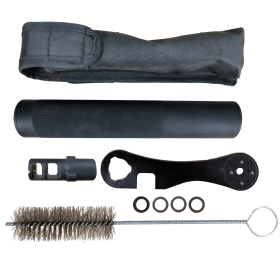
A perfectly mounted accessory can shift an entire assembly by several centimeters. This phenomenon is not necessarily a defect: it mainly reveals that the weapon now operates as a different mechanical system.
A shooter finishes adjusting his rifle.
The results are clean.
At 100 meters, the shots form a regular grouping at the center of the target.
The optical assembly is controlled.
The ammunition is known.
The position is stable.
The rifle reacts exactly as expected.
The shooter then installs a sound suppressor at the end of the barrel.
Same position.
Same distance.
Same ammunition box.
Same pace.
He is shooting a new series.
The group remains tight.
But it is no longer in the same place.
The impacts appear several centimeters lower, sometimes slightly to the left or right.
The first reaction is often immediate:
" The moderator "disrupts the weapon."
Or:
"It causes a loss of precision."
However, these conclusions are often incorrect.
A shift in the point of impact does not automatically mean that accuracy has deteriorated.
If the impacts remain grouped, the weapon retains its ability to reproduce the same result.
Its average point has simply changed.
This difference is fundamental.
The moderator add mass to the muzzle of the barrel.
It changes the balance of the rifle.
It changes the vibrational behavior of the tube.
It acts on the gases after the projectile exits.
It can slightly modify the measured speed.
It sometimes changes the way the shooter manages the recoil.
The weapon equipped is therefore no longer exactly the same mechanical system as the bare weapon.
The displacement of the point of impact then becomes a predictable consequence.
The real question is not whether the point moves.
It is to determine whether this movement remains constant, reproducible, and mechanically sound.
Shift of the impact point and loss of accuracy: two different phenomena
Before going any further, it is necessary to distinguish between two concepts.
The displacement of the point of impact
The entire group moves onto the target.
It may still be as tight as before, but its center changes.
The degradation of accuracy
The group is opening up.
The impacts become more dispersed.
Repeatability decreases.
These two phenomena can occur together, but it is not mandatory.
A rifle can group shots within 25 millimeters without a suppressor, then still group within 25 millimeters with the device, but eight centimeters lower.
In this case, the mechanical precision has not actually decreased.
The setting corresponding to this new configuration simply needs to be known.
Conversely, if the grouping increases from 25 to 80 millimeters, there is likely an additional anomaly to investigate.
The mass added to the mouth transforms the barrel.
One sound moderator represents a mass installed at the end of the barrel.
Even when it seems relatively light, its positioning amplifies its influence.
Imagine a bar held horizontally.
Adding 300 grams near your hand remains relatively easy to control.
Adding the same 300 grams at the very end of the bar creates a much greater effect.
The cannon reacts in a similar way.
The mass added to its end modifies:
- its inertia ;
- its static flexion ;
- its vibration frequencies ;
- its center of gravity ;
- His reaction to the departure then.
The tube does not necessarily become less accurate.
It simply vibrates according to a different mode.
The projectile then leaves the muzzle at a slightly different moment of this new vibratory cycle.
This variation is enough to shift the average position of the grouping.
The cannon never remains perfectly still during firing.
At the start of the stroke, several phenomena occur almost simultaneously:
- The pressure increases in the chamber ;
- The projectile takes the rifling ;
- It accelerates in the barrel ;
- the action and the crossbow absorb the constraints ;
- The cannon vibrates ;
- The gases move behind the projectile ;
- The entire weapon recoils.
The cannon behaves like an elastic structure.
It bends and oscillates microscopically.
These movements are invisible to the naked eye, but they influence the exact orientation of the mouth when the projectile exits.
When a moderator is installed, the mass, length, and distribution of stresses change.
The vibrations do not disappear.
They are modified.
This is one of the main reasons for the change in the point of impact.
Why is the movement often vertical?
Many shooters observe a lower point of impact after installing a suppressor.
The mass added to the end of the barrel can cause a slight additional downward bending.
But this explanation is not always sufficient.
The vertical change can also result from:
- of a new harmonic behavior ;
- a modification of the setback ;
- a change in the shooter's position ;
- of a change in speed ;
- on the influence of gases in the device.
It would therefore be too simplistic to say that the weight "causes the barrel to fall."
The actual direction of the movement depends on the entire configuration.
Some weapons shoot lower.
Others higher up.
Some move sideways.
Others remain almost unchanged.
Threading constitutes the first critical interface.
The silencer is generally mounted on a direct thread or on an intermediate interface.
This area must fulfill several functions:
- hold the device firmly ;
- respect the axis of the barrel ;
- allow for a repeatable installation ;
- Avoid any movement during the shot ;
- ensure sufficient clearance for the projectile.
A thread may appear correct externally while being imperfectly aligned with the bore of the barrel.
The outer diameter of the tube and the actual axis of the core are not necessarily mathematically identical.
For this reason, a precision threading must be made with reference to the axis of the projectile passage, and not solely to the outer surface of the barrel.
A misalignment can cause:
- dispersion ;
- internal contact ;
- instability ;
- variation of impact point ;
- more serious mechanical risk.
Any threading or reworking operation must be entrusted to a competent professional.
The repeatability of the setup is more important than the absence of movement.
A moderator can produce significant displacement while remaining perfectly usable.
Example:
- without device: centered grouping ;
- with device: grouping five centimeters lower ;
- After disassembly and reassembly: systematic return to the same place.
The system is then reproducible.
The shooter can know his two settings.
The problem arises when the point of impact changes with each installation.
First session: four centimeters lower.
Second session: six centimeters lower and two to the right.
Third session: different movement.
This lack of repeatability may reveal:
- dirty contact surface ;
- variable tightening ;
- worn interface ;
- device improperly positioned ;
- damaged threading ;
- accumulation of residues ;
- assembly that loosens.
A good system does not necessarily have to maintain exactly the same point of impact with and without a moderator.
He must especially find the same stitch when he has knitted back in the same way.
Why "squeezing as hard as possible" is a bad logic
The moderator must be installed in accordance with the manufacturer's recommendations.
Insufficient tightening can allow for gradual loosening.
But excessive tightening can also create problems:
- difficulty of disassembly ;
- unnecessary constraints ;
- damage to the threading ;
- imperfect repeatability ;
- Seizure according to materials and conditions.
The right method is not maximum strength.
It is the repeatable method.
Same interface.
Same cleanliness.
Same position.
Same pair or same recommended procedure.
As with an optical assembly, mechanical regularity matters more than the feeling of solidity.
The gases continue to act after the projectile exits.
When the base of the projectile leaves the muzzle, the gases remain under pressure.
Without moderator, They relax quickly in the air.
With a device, they are captured and slowed down through different internal chambers.
This gas management reduces the perceived sound intensity and can alter the exhaust note.
It also modifies the immediate environment in which the projectile makes its first few centimeters of flight.
On a properly aligned system, the ball passes through the device without contact.
But the internal geometry, volume, pressure, and turbulence can contribute to the overall behavior.
The influence remains normally steady.
If it becomes asymmetrical or unstable, you should check for an alignment issue, tightening problem, or clogging.
Is a slight variation in speed possible ?
Yes, but it is not systematic and often remains modest.
Depending on the ammunition, the barrel, and the device, a difference in measured speed may appear.
However, at short range, the observed change in point of impact is often more related to the mechanical behavior of the barrel than to a small variation in velocity.
Over longer distances, a consistent difference in speed can become more noticeable in the trajectory.
That is why demanding shooters can chronograph their ammunition:
- without moderator ;
- with moderator ;
- on several series ;
- under comparable conditions.
The goal is not to seek a spectacular value.
It is to verify the consistency of the system.
Softer recoil can change the shooter's behavior.
The displacement of the point of impact does not always come solely from the weapon.
The moderator can change the feel of the shot.
The setback sometimes appears:
- less brutal ;
- more progressive ;
- different in its impulse ;
- accompanied by a reduced elevation.
The shooter can then change unconsciously:
- its pressure in the shoulder ;
- its handling ;
- its monitoring ;
- its tightening ;
- its head position.
Part of the observed movement may therefore come from the interaction between the new mechanical behavior and the shooter.
To distinguish the causes, it is necessary to work with a very stable and reproducible position.
The forward weight alters the balance of the rifle.
A rifle equipped with a suppressor generally becomes front-heavy.
This modification can be appreciated in benchrest shooting.
The weapon seems more stable.
She moves less easily.
But it can become more tiring:
- in standing shooting ;
- in active hunting ;
- during an extended trip ;
- during a quick clean.
Fatigue then affects practical accuracy.
The shooter should therefore not judge the configuration solely from a table.
The actual effectiveness depends on the usage.
Excellent stability on a bipod can turn into a penalizing imbalance during a hunt that requires several hours of walking.
Thin barrels are often more sensitive to added mass.
A thin tube generally has less stiffness than a heavy profile.
The addition of a mass at the end can therefore more strongly modify:
- its bending ;
- his/her balance ;
- its vibrations ;
- its thermal behavior.
This does not mean that a thin barrel is incompatible with a suppressor.
Many hunting rifles work perfectly this way.
But their impact point displacement can be more pronounced.
A heavy cannon may seem less sensitive due to its rigidity and initial mass.
Again, no absolute rule can replace actual testing.
The temperature of the device becomes a new variable.
After several shots, the moderator heats up.
Sometimes very quickly.
This heat can be transferred to the barrel and influence the optical environment.
One of the most visible phenomena is the heat mirage.
The air heated above the device distorts the image observed through the telescope.
The reticle appears to move.
The target is wavering.
The shooter can then create a spread that does not come directly from the mechanics.
In long series, it is therefore necessary to distinguish:
- Real mechanical evolution ;
- thermal mirage ;
- shooter fatigue ;
- barrel heating ;
- heating of the device.
A group opening up after many shots does not automatically indicate a flaw in the moderator.
The heat mirage can appear very quickly.
At high magnification, a few shots can be enough to create a visual disturbance.
The hot air rises in front of the lens.
The shooter believes that the target is moving slightly.
He corrects.
Then the image changes again.
This situation is particularly important in precision shooting.
Appropriate thermal protections can sometimes reduce the phenomenon, but they must be used correctly and do not replace the management of the firing rate.
The first check remains simple:
Let the setup cool down and compare the results.
Can the fouling of the moderator affect the impact point ?
A device gradually accumulates residues.
The quantity and nature of this fouling depend on:
- of the caliber ;
- ammunition ;
- of the number of shots ;
- of the design ;
- of internal volume ;
- maintenance instructions.
Regular clogging does not necessarily cause an immediately noticeable change.
But a significant or asymmetrical accumulation can alter:
- the mass ;
- the passage of gases ;
- repeatability ;
- the quality of the assembly.
Maintenance must always follow the manufacturer's recommendations.
Some devices are detachable.
Others are not.
You should never improvise a disassembly or use an unapproved product.
Humidity and condensation must not be neglected.
After firing, the device contains hot residues.
When it cools down, condensation may appear.
Prolonged storage of a rifle with a moderator that is still wet or heavily fouled can create an unfavorable environment for the muzzle and the threading.
A reasonable routine consists of:
- let cool ;
- follow the disassembly instructions ;
- check the status of the interfaces ;
- store the equipment in good conditions ;
- Avoid trapping moisture permanently.
This precaution concerns both durability and mechanical repeatability.
Why can the first shot behave differently?
Some shooters observe a slightly different initial impact with a cold and clean device.
The following shots then stabilize the grouping.
Several factors can contribute:
- initial temperature ;
- residuals present ;
- State of the air contained in the chambers ;
- humidity ;
- behavior of the cold cannon ;
- clean or dirty condition.
This phenomenon must be measured before being asserted.
A single offset first shot is not enough.
The test must be repeated over several sessions, under consistent conditions.
For a hunter, knowledge of the first cold shot holds particular importance.
The risk of internal contact
The projectile must pass through the device without touching the internal components.
A contact can cause:
- deformation of the projectile ;
- strong dispersion ;
- internal deterioration ;
- noise or unusual sensation ;
- mechanical hazard.
Possible causes include:
- misalignment ;
- incorrect threading ;
- loose device ;
- internal part displaced ;
- incompatible assembly ;
- lack of concentricity.
Any suspicion of contact must lead to stopping use and having the system checked.
You should not keep pulling to "see if it goes back into place."
The signs that should raise concern
Several symptoms warrant immediate evaluation:
- group that opens abruptly ;
- different movement with each assembly ;
- device that loosens ;
- internal contact trace ;
- unusual noise ;
- abnormal resistance during assembly ;
- damaged threading ;
- significant asymmetric deposit ;
- projectile or target showing abnormal behavior ;
- sudden variation after several stable sessions.
A regular commute is not necessarily problematic.
An irregular evolution is even more so.
Should the weapon be zeroed with or without a suppressor ?
The answer depends on the configuration actually used.
A rifle should ideally be adjusted in the condition in which it will be used.
If the device remains mounted during the majority of the shots, the main zero must correspond to this configuration.
If the user alternates regularly, they must know both points of impact.
He can keep a sheet or a notebook indicating:
- ammunition ;
- distance ;
- approximate temperature ;
- impact point with device ;
- impact point without device ;
- Possible difference from the first shot ;
- number of clicks required.
Memory alone quickly becomes inaccurate.
Why you should not simply count the theoretical clicks
Suppose the group moves from five centimeters to 100 meters.
The shooter can calculate a correction.
But this value must be validated on the target.
The clicks indicated by the scope, the actual conditions, and the shooter's position can create small differences.
The best practice is to:
- measure the actual displacement ;
- apply a calculated correction ;
- carry out a new series ;
- confirm the result.
A setting is never complete until it has been checked.
Test with one bullet at a time
To understand the effect of the device, it is necessary to limit the variables.
Same reference.
Same batch if possible.
Same distance.
Same position.
Same pace.
If the shooter simultaneously changes the ammunition, the suppressor, and the optical setting, no reliable conclusion can be drawn.
A proper approach compares:
- bare configuration ;
- equipped configuration ;
- several series ;
- disassembly and reassembly ;
- repeatability of the result.
Simple range comparison protocol
In a legal, secure framework and in accordance with the booth instructions:
Series 1: configuration without device
Create a reference grouping.
Series 2: equipped configuration
Install according to the recommended procedure and pull a comparable series.
Series 3: confirmation
Let cool if necessary, then repeat.
Series 4: reassembly test
Disassemble, check the interfaces, reassemble, then verify if the point returns to the same place.
Analysis
Compare:
- size of the groups ;
- average displacement ;
- regularity ;
- behavior of the first shot ;
- weapon reaction ;
- Warm-up.
The goal is not to accumulate cartridges.
It is about obtaining actionable data.
A single target can cause confusion
When multiple configurations are fired at the same target, the impacts become difficult to attribute.
It is preferable to use:
- several areas ;
- several visuals ;
- different tablets ;
- precise annotations.
Each series must be able to be identified.
Without this, the shooter risks seeing a general dispersion while simply observing two distinct groupings corresponding to two different zeroes.
The moderator can sometimes improve the grouping.
Yes, that can happen.
The added mass and the modification of the vibrational mode can produce a particularly favorable configuration with a given ammunition.
Softer recoil can also help the shooter execute a better release and follow-through.
But this result is not guaranteed.
The device should not be presented as an accessory that automatically improves accuracy.
He changes the system.
This change can be favorable, neutral, or unfavorable depending on the combination.
It can also reveal a defect that is already present.
A rifle featuring a muzzle interface, threading, or an imperfect fit can function properly without an accessory.
The installation of an additional mass then reveals the problem.
The shooter charges the device.
But this one has sometimes only highlighted:
- a bad threading ;
- an irregular mouth ;
- a very flexible cannon ;
- a dirty interface ;
- an insufficiently reproducible assembly.
The diagnosis must therefore consider the entire weapon.
The choice of the device must correspond to the barrel and the usage.
Several criteria matter:
- planned capacity ;
- internal passage diameter ;
- type of assembly ;
- mass ;
- length ;
- Balance ;
- thermal resistance ;
- frequency of use ;
- manufacturer's recommendations.
A particularly heavy device can be very stable on a precision rifle with a heavy barrel.
It can become less comfortable on a lightweight hunting rifle.
The best choice is not only the one that reduces noise the most.
It is the one that integrates correctly into the complete system.
The effect on semi-automatic weapons
On some semi-automatic platforms, the device can also modify the gas dynamics and the operation of the cycle.
According to the design, it can influence:
- bolt speed ;
- clogging; contamination; fouling ;
- feeling of setback ;
- mechanical cadence ;
- Ejection ;
- wear of certain parts.
This topic goes beyond the simple displacement of the point of impact.
It shows once again that a moderator is not just a tube added to the muzzle.
It is involved in the overall operation of the platform.
All compatibility must be verified according to the manufacturer's recommendations and by a professional when necessary.
Why hunting makes repeatability even more important
A hunting rifle can be carried, disassembled, cleaned, or equipped depending on the outings.
The device is sometimes removed for storage or transport.
He must then return to exactly the same position.
A variation of several centimeters can become significant depending on the distance and the size of the targeted area.
The hunter must therefore know:
- the actual point of impact ;
- the first cold shot ;
- repeatability after reassembly ;
- the behavior with its hunting ammunition ;
- the tightening stability.
This check must be done before departure, not discovered in the field.
The most common mistakes
The common mistakes are:
- to believe that a movement necessarily means a loss of accuracy ;
- assemble the device on a dirty interface ;
- to squeeze randomly ;
- forget to check for loosening ;
- adjust the weapon without reproducing the actual configuration ;
- change ammunition during the test ;
- ignore the heating and the mirage ;
- Assume that the stitch will automatically return after reassembly ;
- neglect the alignment of the threading ;
- continue to pull after an internal contact sign ;
- store the weapon long-term with a damp device ;
- Compare two groups without specifying the conditions.
These errors prevent understanding what the system actually produces.
Mini-method Atlas Defense: validating an equipped configuration
1. Check compatibility
Caliber, threading, interface, and recommendations.
2. Clean the contact surfaces
Without introducing an unsuitable product or tool.
3. Install according to the manufacturer's procedure
Always in the same way.
4. Create a reference grouping
With the ammunition actually used.
5. Measure the displacement
Horizontally and vertically.
6. Compare the size of the groups
Movement or true dispersion ?
7. Test the disassembly and reassembly
Is the point coming back ?
8. Observe the heating
Canon, device, and optical mirage.
9. Note the results
Distance, ammunition, clicks, and first shot behavior.
10. Stop in case of an anomaly
Any sign of contact or instability must be checked before proceeding.
SEO FAQ
Does a suppressor change the point of impact ?
Yes, it can shift the grouping by changing the mass, balance, and vibrations of the barrel.
Does a movement mean that the weapon is less accurate ?
No. If the grouping remains tight, the precision is maintained but the zero point has changed.
Why does the point of impact often drop ?
The added mass and the change in vibrations can cause vertical drift, but the direction varies depending on each weapon.
Is it necessary to readjust the setting with the device installed ?
Yes, when this configuration is the one actually used.
Does the point of impact return after disassembly and reassembly ?
A quality assembly must offer good repeatability, but this must be verified on the target.
Can a device improve accuracy ?
Sometimes, if its influence on vibrations and recoil corresponds favorably to the weapon and the ammunition.
Why does the group open with the moderator ?
This can be caused by misalignment, loosening, heating, mirage, an internal contact, or a less favorable weapon-ammunition combination.
Does the threading affect the precision ?
Yes. It must be concentric with the core and allow for a stable assembly.
Why does the image in the scope ripple after several shots ?
The heat from the device can create a thermal mirage in front of the optics.
Can the device be left on the weapon during storage ?
You must follow the manufacturer's recommendations and avoid prolonged exposure to moisture and residues in contact with the mouth and the threading.
Conclusion
A sound moderator does not simply modify the noise produced by the shot.
He changes the weapon.
He adds a mass to the end of the barrel.
Modifies its balance.
Transform its vibrations.
Influences the sensation of recoil.
Add a new mechanical interface.
Create an additional heat source.
The displacement of the point of impact then becomes perfectly understandable.
This movement should not be confused with a loss of accuracy.
A configuration can remain extremely regular while requiring a different zero.
The true criterion is repeatability.
Does the device always return to the same position ?
Does the grouping remain coherent ?
Is the first shot known ?
Is the setup still stable ?
Is the alignment correct ?
Is the rifle adjusted/configured for its actual use setting ?
When a equipped weapon answers these questions positively, the shift in the point of impact does not constitute a mysterious problem.
It is simply the mechanical signature of a new system.
In shooting, adding an accessory never means adding only a function.
It always means changing a balance.
And the good shooter does not try to eliminate all differences.
He learns to measure them, to understand them, and to make them predictable.
Products mentioned in this post