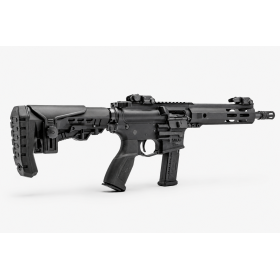
Breaking in a new barrel: mechanical necessity, useful precaution, or simple ritual ?
Some shooters clean their barrel after every cartridge. Others fire a whole box without the slightest precaution. Between the two, each often claims to hold the truth.
The scene takes place at an outdoor booth.
Two shooters have just received a new rifle.
Same enthusiasm.
The same attention given to the equipment.
Same desire to properly leverage their investment.
The first one sets up his weapon with almost surgical precision.
He pulls a cartridge.
Put down the rifle.
Load several patches into the barrel.
Use a product designed to remove copper residues.
Wait.
Control.
Carefully dries the soul.
Then draw a second cartridge.
He is doing exactly the same operation again.
His protocol calls for cleaning after each shot during the first ten cartridges, then after every series of three, and then after every series of five.
A few meters away, the second shooter watches the scene with a slight smile.
He also has a new rifle.
But he adopts an opposite philosophy.
He simply checks that the barrel is clean and clear before the first use.
Then he shoots normally.
Three knocks.
Five shots.
Ten blows.
He lets the weapon cool down, checks his grouping, and continues his session.
For him, the breaking-in of a barrel is essentially a ritual inherited from another era.
A belief maintained by forums, habits, and cleaning product manufacturers.
At the end of the session, the two men are still convinced that they have chosen the best method.
The first one believes he has protected the future of his cannon.
The second believes they have avoided an unnecessary procedure.
Which one is right ?
The answer is less straightforward than a simple yes or no.
Because the breaking-in of a new barrel is neither a universal necessity nor necessarily a complete superstition.
Its effectiveness depends on the quality of the barrel, its manufacturing method, its surface condition, its use, and especially on what the shooter actually means by "breaking in."
The problem begins when a reasonable precaution is turned into a rigid protocol applicable to all weapons.
What exactly is meant by the "breaking-in" of a barrel ?
Breaking-in, often called rodage du canon In English-language publications, it generally refers to an initial phase during which the shooter alternates between firing and cleaning.
The intended goal is to gradually reduce the microscopic irregularities present inside the barrel.
According to the proponents of this method, the first projectiles would help to smooth out certain marks left by the manufacturing process.
Repeated cleaning would then prevent copper and carbon deposits from accumulating on these irregularities before the surface stabilizes.
The claimed benefits are numerous:
-
less significant future clogging ;
-
easier cleaning ; ;
-
better consistency ;
-
more stable precision ;
-
potentially improved lifespan ;
-
reduction of copper deposits.
Presented this way, the logic seems coherent.
The projectile passes through the barrel.
It comes into contact with the scratches.
It exerts pressure and friction.
The first cartridges would contribute to the establishment of the internal surface.
But an essential question remains:
Do all the cannons really need this treatment ?
No.
And that is precisely where the debate begins.
A new barrel is not necessarily a rough surface.
The word "neuf" can cause confusion.
Some imagine that a new barrel comes out of the factory with a rough bore, full of significant imperfections that must be polished by firing.
The industrial reality is much more varied.
Depending on the manufacturer and the product range, a barrel may have been:
-
cold forged ;
-
scratched by rubbing ;
-
scratched by material removal ;
-
made by electrical discharge machining according to certain designs ;
-
mechanically polished or ground ;
-
visually inspected ;
-
selected according to its tolerances ;
-
tested before commercialization.
A standard industrial barrel and a high-end competition barrel therefore do not necessarily leave the workshop in the same condition.
A match barrel manufacturer can pay considerable attention to the internal finish.
In this case, the shooter does not receive a surface that he must finish himself.
He is already receiving a carefully crafted tube.
Conversely, some mass-produced barrels may show more machining marks while remaining perfectly functional and suitable for their intended use.
The potential need for a cautious initial phase therefore depends much more on the actual quality of the barrel than on its mere status as a new barrel.
The projectile does not polish the entire barrel uniformly.
The image of a projectile that would act as a perfect polishing tool is appealing.
But it is simplistic.
The projectile does not encounter all areas of the barrel in the same way.
The chamber, the transition cone, the beginning of the rifling, and the muzzle do not undergo exactly the same stresses.
The area located just after the chamber is particularly stressed.
That is where:
-
The pressure is very high ;
-
The projectile takes the rifling ;
-
The temperature is important. ;
-
The gases begin their action ;
-
Deposits can form quickly.
Running-in therefore does not correspond to a uniform polishing of the entire tube.
It is rather a gradual evolution of the most stressed surfaces.
This change occurs anyway when the weapon is used.
The real question then becomes:
Should this evolution be constantly interrupted for cleaning, or can one simply shoot normally with reasonable maintenance ?
Why do copper deposits hold a central place in the debate?
When the projectile passes through, a small amount of material can be deposited inside the barrel.
Jacketed projectiles sometimes leave traces of copper in the rifling and on certain rougher areas.
A barrel with a very smooth internal finish will generally tend to retain less material than a tube showing more marks.
It is one of the main arguments of proponents of breaking in.
According to them, if the initial deposits accumulate in the irregularities, they can slow down the stabilization of the surface.
Cleaning between the first sets would therefore help to avoid excessive buildup.
The idea is not completely absurd.
But it does not necessarily justify cleaning after each cartridge.
There is a big difference between:
-
monitor the initial fouling ;
-
carry out some reasonable cleanings ;
-
impose an extremely long and aggressive protocol.
Breaking in becomes problematic when the fear of copper leads the shooter to clean more than they shoot.
Carbon and copper do not tell the same story.
The fouling of a barrel is not limited to copper.
The shots also produce carbon residues.
These residues can settle in different areas:
-
room ;
-
connecting cone ;
-
stripes ;
-
mouth ;
-
muzzle brake or device mounted at the end.
Copper sometimes provides information about the quality of the internal surface and how the projectile interacts with the barrel.
Carbon depends more on combustion, ammunition, rate of fire, and general maintenance.
A shooter who observes very dirty patches after the first cartridges should not automatically conclude that their barrel is wearing out poorly or requires an extended break-in period.
He must distinguish:
-
combustion deposits ;
-
traces of lubricant or factory protection ;
-
copper residues ;
-
dirt coming from storage or from the transport.
This distinction avoids many excessive conclusions.
The first cleaning should precede the first shot.
Whatever the viewpoint on breaking in, one precaution remains reasonable: carefully inspecting and cleaning a new barrel before its first use.
A new weapon can contain:
-
protective oil ;
-
fat ;
-
dust ;
-
packaging residues ;
-
traces resulting from factory inspection ;
-
accidental foreign body.
Before any intervention, the weapon must naturally be completely discharged, secured and separated from any ammunition present in the work area.
The first cleaning is not meant to break in the barrel.
It is used to check that the soul is clean, dry, and free of any obstruction.
This simple step is much more important than most of the complicated rituals performed afterwards.
A new barrel should never be considered ready to fire without inspection.
The manufacturer's recommendations should take precedence over those from forums.
This is probably the most important rule.
Some manufacturers recommend an initial procedure.
Others specify that no special break-in is necessary.
Others simply recommend a normal cleaning after the first sets.
These differences are not necessarily contradictory.
Manufacturers do not all produce the same barrels.
They know:
-
their manufacturing method ;
-
their level of finish ;
-
the materials used ;
-
the treatments applied ;
-
the controls carried out ;
-
the accepted tolerances.
When an official procedure exists, it is therefore the first document to consult.
A protocol found on a forum should never replace the manufacturer's instructions.
Especially when it was designed for another type of barrel, another caliber, or another manufacturing method.
Why do some manufacturers still recommend a break-in period ?
Several reasons can explain this recommendation.
First possibility: the manufacturer truly believes that an initial phase of firing and cleaning reduces future fouling.
Second possibility: he wants to impose a cautious observation period before the shooter starts firing long series.
Third possibility: the protocol allows the owner to gradually learn the behavior of their cannon.
Fourth possibility: some recommendations are also passed down through industrial tradition.
A procedure may continue to exist because it has always been applied, without it being easy to precisely identify its benefit.
That does not mean that it is useless.
But this reminds us that a protocol is not always proof of an absolute necessity.
The main risk is sometimes not the lack of running-in, but excessive cleaning.
A cannon can be damaged by poor maintenance.
This reality is sometimes forgotten by those who absolutely want to protect it.
The risks come notably from:
-
poorly guided baguette ;
-
repeated rubbing on the crown ;
-
Unsuitable swab ;
-
product too harsh ;
-
excessive contact time ;
-
useless abrasion ;
-
improperly disposed product deposit ;
-
cleaning performed through the mouth when the design would allow for another access ;
-
brutal manipulation.
The crown of the barrel plays an essential role in the regular release of gases around the projectile.
A degradation, even slight, can affect accuracy.
Cleaning a barrel twenty times with a poor technique can therefore be much more harmful than firing a few additional rounds before maintenance.
The word "cleaning" does not automatically mean "protection."
A good cleaning protects.
Poor cleaning causes wear.
The maintenance equipment is just as important as the product used.
A cautious method generally uses equipment suited to the diameter and design of the barrel.
The goal is to avoid any unnecessary contact with sensitive areas.
A properly fitted wand guide can notably help to keep the tool aligned when the weapon's configuration allows it.
The patches must be adjusted without requiring excessive force.
The swabs must match the size.
The product must be compatible with the materials and treatments.
But the most important thing remains the method.
A highly effective product used without proper knowledge can cause more problems than a simple maintenance task done correctly.
Patience, cleanliness, and adherence to instructions are worth more than an accumulation of specialized solvents.
A cannon does not need to be chemically sterile to shoot well.
It is an important idea.
Many shooters believe that a perfectly clean barrel should produce the best possible accuracy.
That is not always the case.
Some weapons reach their most consistent behavior after a few shots.
A slight stable state of fouling can provide better consistency than a barrel that is completely stripped after each session.
We then distinguish several situations:
-
clean and cold cannon ;
-
slightly clogged and cold barrel ;
-
hot cannon ;
-
heavily clogged printhead ;
-
barrel containing oil residues.
These states can produce slightly different impact points.
A marksman must therefore know the actual behavior of their weapon.
It is not enough to say:
"My barrel is clean."
You need to know how he shoots when he is clean.
And how many cartridges are possibly needed before it regains its usual point of impact.
The first shot after cleaning may be different.
This variation is often called the difference between shooting with a clean barrel and subsequent shots.
It can be influenced by:
-
residual presence of product ;
-
oil film ;
-
Surface condition ;
-
initial deposit of carbon or copper ;
-
temperature ;
-
position of the weapon.
For a hunter, this information is particularly important.
The weapon can remain stored clean for several weeks before being used.
The first shot fired under this condition must therefore be known.
For a competitor, the logic can be different.
He may prefer to arrive with a barrel already stabilized by a few shots, when the rules and organization of the discipline allow it.
The initial break-in should therefore not be considered separately from the final use of the weapon.
Why are competition barrels often treated differently?
A competition barrel generally represents a significant investment.
It is used with high requirements.
The shooter is looking for:
-
reduced groupings ;
-
steady speed ;
-
repeatability ;
-
controlled fouling ;
-
monitored lifespan ;
-
known behavior when hot and cold.
In this context, some owners prefer to apply a very methodical initial procedure.
Not necessarily because they have absolute proof that it improves accuracy.
But because they want to observe the tube from the very first shots.
They can follow:
-
amount of copper deposited ;
-
ease of cleaning ;
-
Evolution of groups ;
-
number of shots ;
-
speed ;
-
thermal stability.
The break-in then also becomes a diagnostic phase.
This approach can make sense.
Provided that each improvement is not attributed solely to the protocol.
The shooter simultaneously learns about their weapon, their ammunition, and their equipment.
It therefore becomes difficult to precisely separate the causes.
For a hunting rifle, the need is different.
A lightweight hunting rifle does not have the same specifications as a competition platform.
It must above all offer:
-
a reliable first shot ;
-
a sufficient accuracy for the intended distance ;
-
a stable behavior in cold conditions ;
-
ease of maintenance ;
-
good resistance to external conditions.
Imposing several dozen cycles of firing and cleaning does not necessarily provide a proportional value.
A simpler approach can be perfectly consistent:
-
initial inspection ;
-
careful cleaning ;
-
first limited edition ;
-
behavior control ;
-
Regular maintenance according to the level of soiling and the manufacturer's recommendations.
The shooter must especially know the point of impact of the first shot on a cold barrel.
It is often this data that holds the most value in the field.
Breaking in will never fix a manufacturing defect.
It is an essential limit.
A break-in protocol will not turn a bad barrel into a match-grade barrel.
He will not correct:
-
poorly done room ;
-
significant concentricity defect ;
-
damaged crown ;
-
misalignment ;
-
irregular stripes ;
-
metallurgical defect ;
-
mechanical stress originating from the assembly.
If a firearm shows abnormally poor grouping, you should not continue firing dozens of rounds hoping that the barrel will eventually become accurate.
You must first check:
-
assembly optics ; ;
-
action screw ;
-
supports ;
-
ammunition ;
-
Condition of the mouth ;
-
absence of abnormal contact with the crossbow ; ;
-
quality of the shooter's technique.
Breaking-in should never be used as a universal explanation for a problem that is not understood.
An improvement during the first sessions does not necessarily prove the effectiveness of the break-in.
Many shooters observe an improvement after several dozen cartridges.
They then conclude that their protocol worked.
It's possible.
But other factors are evolving simultaneously.
The shooter learns:
-
relaxation ; ;
-
the position ;
-
the cheek hold ;
-
the ammunition ;
-
the adjustment of the optics ;
-
the behavior of recoil.
The mechanical assembly can also stabilize.
The chosen ammunition can change.
The weather conditions can be different.
The observed improvement cannot therefore always be attributed to the break-in period.
It is a classic error of interpretation.
Two events occur successively.
This does not automatically mean that the first caused the second.
Abrasive projectile honing: another category not to be confused with
Some processes use projectiles or components containing an abrasive material intended to act more strongly on the bore of the barrel.
This practice is sometimes presented as a solution to smooth a rough tube.
It should not be confused with a simple alternation between shooting and cleaning.
The abrasive action removes material.
It can therefore actually modify certain surfaces.
This also involves more risks:
-
accelerated wear ;
-
modification of the connecting cone ;
-
alteration of dimensions ;
-
irreversible result ;
-
different effect depending on the barrel.
This type of intervention should not be improvised.
On a properly manufactured new barrel, deliberately removing material without clear guidance can be counterproductive.
In the event of an actual defect, the opinion of a gunsmith or manufacturer is preferable to irreversible experimentation.
Can we observe the inside of the barrel ?
A suitable endoscope allows for the visual inspection of certain areas of the core.
This tool can show:
-
deposits ;
-
manufacturing brands ;
-
Condition of the transition cone ;
-
Evolution of erosion ;
-
unusual traces.
But the image must be interpreted with caution.
A significant magnification makes every detail spectacular.
A mark that appears huge on a screen can be tiny in reality.
Conversely, a visually imperfect barrel can very well produce excellent groupings.
The endoscope is therefore an observation tool.
Not an absolute judge of accuracy.
The target remains the most important measure.
A cannon should be evaluated by what it produces, not solely by the enlarged appearance of its internal surface.
The best method is sometimes to observe rather than to ritualize.
Between the complete refusal of running-in and the extreme protocol, an intermediate approach exists.
It consists of:
-
follow the manufacturer's recommendations ;
-
clean carefully before first use ;
-
produce small batches initially ;
-
let the weapon cool down ;
-
observe the clogging ;
-
control the groups ;
-
to conduct a reasonable interview ;
-
adapt the frequency according to the actual behavior.
This method does not assume that all cannons require the same treatment.
It corresponds to what the weapon actually shows.
If the barrel deposits a lot of copper during the first series, more frequent cleaning may be appropriate.
If the patches become clean quickly and the accuracy remains stable, there is no necessarily justified reason to continue a heavy protocol.
The shooter thus moves from a belief to an observation.
How can you tell if the initial phase is completed ?
There is no universal threshold.
But several signs can indicate that the behavior is stabilizing:
-
faster cleaning ;
-
reduction of copper traces ;
-
coherent groupings ;
-
stable impact point ;
-
regular response with the same ammunition ;
-
no significant change between the series.
Be careful, however, not to turn every patch into a scientific test.
The color of a patch can depend on the product, the material used, and the contact time.
The objective is to identify a general trend.
Do not seek absolute purity.
Should you clean after each cartridge ?
In most common uses, this method is difficult to justify as a universal rule.
It can be recommended by certain manufacturers or chosen to observe a particular barrel.
But it also has several disadvantages:
-
very long session ;
-
multiplication of manipulations ;
-
risk of poorly performed maintenance ;
-
permanent cooling that moves away from real conditions ;
-
difficulty in distinguishing mechanical benefit from simple ritual.
Cleaning after each cartridge should therefore not be adopted solely because another shooter practices it.
It is necessary to understand why this method would be relevant for the canon in question.
Should we, on the contrary, do nothing at all ?
Completely ignoring the condition of a new cannon is not necessarily more rational.
A new weapon deserves an inspection.
She also deserves initial follow-up.
The shooter must check:
-
cleanliness ;
-
security ;
-
absence of obstruction ;
-
behavior of the first shots ;
-
stability of the setup ;
-
abnormal clogging ;
-
general operation.
The refusal of any interview can become as dogmatic as excessive breaking-in.
The right method is not the one that requires the least amount of work.
It is the one that meets the real need of the equipment.
The role of the ammunition during the initial shots
The initial phase should ideally be carried out with regular ammunition that is suitable for the weapon.
Constantly changing the reference makes the analysis difficult.
A different ammunition can modify:
-
pressure ;
-
speed ;
-
quantity of residues ;
-
copper deposit ;
-
grouping ;
-
barrel temperature.
If the shooter uses three types of cartridges during the initial series, it becomes almost impossible to determine whether the variation comes from the barrel or the ammunition.
The consistency of the tests is therefore more important than a complicated protocol.
The rate of fire must remain reasonable.
Breaking-in is often associated with cleaning, but thermal management is just as important.
Rapidly firing many rounds through a new barrel does not necessarily provide an advantage.
The barrel is heating up.
The conditions are changing.
The groupings become more difficult to compare.
A measured rhythm allows:
-
to observe properly ;
-
to limit the heating ;
-
to verify the initial results ;
-
to avoid rushing ;
-
to control security.
The goal is not to treat the cannon as a fragile object.
It is simply a matter of not turning the first session into an unnecessary endurance test.
The true practice also concerns the shooter.
This is perhaps the most important part.
During the first sessions, the shooter also learns how to use their weapon.
He discovers:
-
his relaxation ; ;
-
his/her/its balance ;
-
his/her/its stick ;
-
his/her cheek grab ;
-
its setback ;
-
his/her/its ammunition ;
-
his behavior when cold.
This human adaptation often influences the results more than the microscopic evolution of the soul.
The shooter who spends all their time cleaning may neglect this genuine learning.
A new weapon must be understood.
Not just maintained.
Mini-method Atlas Defense: a reasonable commissioning
1. Read the manufacturer's documentation
Check for the existence of an official procedure.
2. Secure and inspect the weapon
Weapon unloaded, ammunition removed, chamber and barrel checked.
3. Perform an initial careful cleaning
Remove the protective products and check for any obstructions.
4. Use consistent ammunition
Avoid multiplying references during the initial observation.
5. Producing small batches
Control the operation, the groupings, and the heating.
6. Observe the soiling/clogging
Clean according to the recommendations and the behavior actually observed.
7. Avoid aggressiveness
No product or tool should be used without proper mastery.
8. Note the results
Number of shots, ammunition, groupings, clean or fouled condition.
9. Learn the first shot
Compare the behavior on a clean, slightly fouled, and cold barrel.
10. Consult a professional in case of an anomaly
A real mechanical defect cannot be fixed with a cleaning ritual.
Common mistakes
The most common mistakes are:
-
apply the same protocol to all the cannons ;
-
ignore the manufacturer's instructions ;
-
clean from the mouth without precaution ;
-
use too much product ;
-
let a solvent act for too long ;
-
search for a perfectly white patch at all costs ;
-
to confuse copper and carbon ;
-
to believe that running-in corrects poor manufacturing ;
-
change ammunition during each series ;
-
attribute any improvement solely to the break-in ;
-
neglect the behavior of the first cold shot ;
-
to forget that cleaning itself can cause wear.
These mistakes often come from good intentions.
But protecting the equipment requires more method than zeal.
FAQ
Is it necessary to break in a new barrel ?
It depends on the manufacturer, the barrel finish, and the intended use. There is no universal protocol applicable to all firearms.
What does the breaking-in (or bedding-in) of a barrel consist of ?
It generally involves alternating the first series of shots with cleanings in order to monitor and limit the initial fouling.
Should you clean after each cartridge ?
Not systematically. This method should only be applied when it is recommended or justified by the behavior of the barrel.
Does running-in improve accuracy ?
It can facilitate maintenance or stabilize the fouling of certain barrels, but it does not turn a mediocre barrel into a competition-grade barrel.
Should a new barrel be cleaned before the first shot ?
Yes, a careful inspection and cleaning remove protective products and check for the absence of obstruction.
Can a barrel be damaged by cleaning it too often ?
Yes. A bad baguette, an unsuitable tool, or a product that is too harsh can damage certain sensitive areas.
Why does a new barrel leave copper deposits ?
Jacketed projectiles can leave copper on the microscopic irregularities of the internal surface.
Does a clean barrel always shoot better ?
No. Some weapons become more consistent after a few shots of fouling.
How can you tell if a barrel is stabilized ?
When the groupings, the point of impact, and the ease of cleaning become consistent over several series.
Is abrasive running-in recommended ?
It must not be improvised. It removes material and can cause irreversible changes.
Conclusion
Breaking in a new barrel has become one of the most polarizing topics in sport shooting.
On one side, those who consider each initial cleaning as essential.
On the other hand, those who reject the entire practice as superstition.
The reality lies between the two.
A new cannon deserves an inspection.
A first cleaning.
A gradual commissioning.
An observation of his/her behavior.
But that does not mean that a fifty-step protocol should be blindly applied to every weapon.
Cannons are not all made in the same way.
They do not all have the same surface condition.
They do not serve the same purpose.
They do not produce the same fouling.
The best protocol is therefore the one that first respects the manufacturer's recommendations, then adapts to what the barrel actually shows.
The danger is not only in not cleaning enough.
It is also about cleaning too often, too aggressively, or with inappropriate equipment.
A cannon does not need a ritual.
He needs a method.
And in sport shooting, a serious method always starts with the same thing:
observe before concluding.
Products mentioned in this post