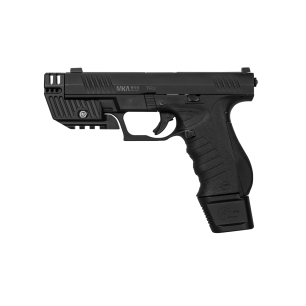
Why do most shooters grip their weapon way too tightly?
Many shooters think that a well-held gun is one that is gripped tightly. In reality, a grip that is too tense can ruin accuracy even before the shot is fired.
On a firing range, the same scene is often observed.
A shooter takes his weapon.
He is concentrating.
He locks his arms.
He tightens the handle.
He is blocking the shoulders.
He wants to be stable.
He wants to control the recoil.
He wants to prevent the weapon from moving.
His intention is good.
But the result is sometimes exactly the opposite.
The tighter he squeezes, the more he trembles.
The more he locks, the more he loses fluidity.
The more he wants to control the weapon, the more he creates unwanted tensions.
And on the target, it eventually appears.
Delayed impacts.
Grouping that opens.
Sudden sharp departure.
Rapid fatigue.
Loss of sensation on the trigger.
The shooter then thinks they lack technique.
He sometimes blames the trigger, the ammunition, the weapon, or his position.
But the problem is often much simpler:
He is squeezing too hard.
In sport shooting, stability does not come from brute strength.
It comes from regularity.
And an effective grip is not a tense grip.
It is a controlled, consistent, reproducible, and appropriate intake.
The great misunderstanding: confusing firmness with tension
Many beginner shooters hear a common instruction:
"Hold your weapon firmly."
The problem is that this sentence is often misinterpreted.
For some, "holding well" means:
-
tighten as much as possible ;
-
lock the hand ;
-
contract the forearm ;
-
block the shoulders ;
-
to prevent any movement.
But holding a weapon correctly does not mean crushing it.
A good grip must be firm, yes.
But above all, it must remain neutral.
It must not create any unwanted movement.
It must not disturb. the release.
She must not get tired too quickly.
She must not change position between each shot.
Firmness is useful.
Tension is destructive.
And this difference is one of the first real lessons in sport shooting.
Your hand is not just for holding: it directly influences the start of the stroke.
In handguns, the hand is the main interface between the shooter and the weapon.
She controls:
-
orientation ;
-
pressure ;
-
stability ;
-
the reaction to the setback ;
-
the placement of the finger ;
-
the quality of the release.
If the hand tightens at the wrong moment, the weapon moves.
Even very slightly.
And this slight movement is enough to shift the impact.
The problem is that this tension often occurs just before the start of the stroke.
The shooter is preparing mentally.
He knows that the shot is going to be fired.
He tightens more.
He anticipates.
He is contracting.
And the weapon leaves its alignment.
On target, this can give the impression of a finger twitch, anticipation, or a poor adjustment.
But the root of the problem sometimes comes from a hand that is too tight.
The human body trembles more when it exerts itself too much.
It is a very simple phenomenon.
Try to hold a light object with your arm extended, using maximum contraction.
At first, you will feel solid.
But quickly, the micro-tremors appear.
Why ?
Because a muscle that is strongly contracted tires more quickly.
He is losing finesse.
It produces oscillations.
It transmits tensions to the joints.
In shooting, it’s exactly the same thing.
The more you try to immobilize the weapon by force, the more you risk creating involuntary movements.
Stability therefore does not come from a maximal contraction.
It comes from muscular balance.
A sufficient voltage to control.
But not excessive to the point of causing disruption.
A grip that is too strong destroys the feeling of relaxation.
Relaxation is one of the most sensitive elements of shooting.
To achieve a clean start, the finger must act gradually, along the axis, without moving the rest of the hand.
But if the hand is already clenched, the finger works in a tense environment.
It becomes more difficult to feel:
-
the race ;
-
the hard point ;
-
progressive pressure ;
-
the break ;
-
the maintenance after departure.
The shooter loses precision.
It is no longer urgent.
He tears off.
Or he accompanies the departure with his whole hand.
A grip that is too strong therefore turns the release into a global movement.
Instead of having one finger working independently, the whole hand participates.
And that is precisely what must be avoided.
The strong hand and the weak hand do not have the same role.
In handgun, Many shooters primarily grip tightly with their strong hand.
It makes sense.
It is the one who is holding the weapon.
It is the one whose finger acts on the trigger.
However, it is often a mistake.
The strong hand should allow control of the weapon while letting the finger work properly.
If it is too tight, it disrupts the release.
The weak hand, on the other hand, can play a major role in stability.
It comes to wrap.
Stabilize.
Distribute the pressure.
Limit lateral movements.
Help manage the setback.
A good grip therefore does not rely solely on the strength of the pulling hand.
It is based on an intelligent distribution of pressure.
With a long weapon as well, Tension ruins consistency.
We often talk about excessive recoil in handguns.
But the problem also exists with rifles.
A shooter can:
-
to squeeze the handle too tightly ;
-
pull the stock excessively into the shoulder ;
-
press too hard on the barrel ;
-
load the bipod irregularly ;
-
clench the back hand ;
-
block the neck and shoulders.
Result:
The rifle no longer responds naturally.
She is forced.
The recoil is not the same from one shot to another.
The situation is deteriorating.
The relaxation is less smooth.
The group is opening up.
A rifle must be handled with seriousness.
But it must not be strangled.
It must be able to move backward in a regular and predictable manner.
Consistency matters more than strength.
One principle must remain foremost:
In shooting, consistency is better than intensity.
An average grip but perfectly consistent with each shot will often produce better results than a very strong but variable grip.
The problem with a clenched grip is that it constantly changes.
First shot:
high pressure.
Second shot:
different pressure.
Third shot:
fatigue.
Fourth draw:
micro-relaxation
Fifth shot:
compensation.
The shooter does not realize it.
But her weapon feels it.
And the target shows it.
The recul -> setback / retreat / backward movement (depending on context) It is controlled before the shot, not during.
Many shooters grip tightly because they want to control the recoil.
But the setback should not be "fought" at the last moment.
It must be anticipated by a correct position.
Good management of perspective relies on:
-
body alignment ;
-
consistent handling ;
-
reasonable locking ;
-
stable supports ;
-
constant pressure ;
-
tracking of the shot.
If the shooter tries to overcome the recoil solely by the strength of their hands, they often create unnecessary tension.
The setback must be channeled.
Not crushed.
This is especially true with more powerful calibers or light weapons.
Tension often comes from the fear of leaving.
Many shooters do not grip tightly due to poor technique.
They squeeze too tightly out of instinctive reaction.
The brain knows that something is going to happen.
Noise.
Retreat.
Movement.
He is therefore preparing the body.
The hand closes.
The shoulders rise.
The jaw tightens.
The finger accelerates.
This reaction is normal.
But it must be controlled.
Sport shooting consists precisely in transforming an instinctive reaction into a controlled movement.
And this involves a gradual learning of useful relaxation.
Not soft.
Not passive.
But controlled.
The right level of pressure: enough to control, not enough to disrupt
The question often comes up:
How tight should it be ?
There is no universal figure.
The correct pressure depends on:
-
of the weapon ;
-
of the caliber ;
-
of discipline ;
-
of morphology ;
-
at the shooter's level ;
-
of the position ;
-
of the pace.
But a simple rule exists.
The grip must be firm enough so that the weapon does not float.
But relaxed enough for the finger to work independently.
If your hand pressure prevents a clean release, it is too strong.
If the weapon moves freely in the hand, it is too weak.
The right level is between the two.
Simple exercise: the shaking test
Take a safe shooting position with an empty weapon or an appropriate training tool.
Gradually tighten the handle.
First slightly.
Then moderately.
Then very loud.
Observe what is happening in the arms, the shoulders, and the aiming.
You will often notice that aiming does not improve with maximal contraction.
On the contrary, she becomes more nervous.
This exercise helps to physically understand the difference between holding and tensing.
Simple exercise: isolate the trigger finger
Still in a secure environment, work only on the movement of the finger.
Objective:
press the trigger without the other fingers closing at the same time.
It is much more difficult than it appears.
For many shooters, when the index finger presses, the other fingers unconsciously follow.
It is this parasitic movement that displaces the weapon.
The task is to make the index finger independent.
The hand holds.
The finger presses.
The rest does not move.
This separation is fundamental.
Simple exercise: check the pressure between two shots.
After each departure, ask yourself:
Is my plug the same ?
Did I squeeze harder just before the shot ?
Did I relax after stepping back ?
Have I changed my pressure without realizing it ?
This questioning develops body awareness.
And this awareness is one of the great pillars of progress.
A shooter who does not feel what their hand is doing will have difficulty correcting what their target produces.
The signs that you are squeezing too hard
Several symptoms should raise concern.
You quickly feel fatigue in the forearm.
Your hand trembles at the end of the set.
Your relaxation seems difficult to manage.
Your impacts regularly go off to one side.
Your shoulders are tense.
You are having trouble maintaining the same pressure.
Your group opens up after a few shots.
You feel like you have to "force" yourself to be stable.
All these signs may indicate an overdose.
Not always.
But often enough to warrant a check.
Why do experienced shooters appear more relaxed?
Watch a good shooter.
It does not seem soft.
But he doesn't seem tense either.
His posture gives an impression of calm solidity.
The gestures are clean.
The targeting is smooth.
The start is clear.
After the shot, the weapon naturally returns.
This apparent simplicity is deceptive.
It comes from a long work.
The experienced shooter has learned to tense only what is necessary.
No more.
It is an economy of effort.
And this economy produces regularity.
The hand pressure must remain consistent throughout the entire sequence.
An essential point:
The grip must not change at the moment of departure.
Many shooters mount the weapon with the correct pressure.
Aim.
They are starting to press.
Then, just before the shot, they tighten more.
This sudden change disrupts the weapon.
The pressure must remain constant:
-
before departure ;
-
during the departure ;
-
after the departure.
This is what is called continuity.
The shot does not stop at the click or the trigger.
He continues with the follow-up.
And the hand must remain steady throughout this entire phase.
Fatigue reveals the bad shots
A bad shot can go unnoticed over five shots.
But it often appears after twenty or thirty shots.
The shooter is off to a good start.
Then the grouping opens.
The hand is getting tired.
The wrist becomes less stable.
Relaxation becomes less clean.
The shooter believes he is losing his concentration.
It is sometimes true.
But muscle fatigue related to excessive intake may be the real cause.
A good grip must be durable.
If it doesn't hold up over time, it is probably not optimal.
Application in dynamic shooting
In dynamic shooting, the grip is obviously firmer than in stationary shooting.
The shooter must control:
-
setback ;
-
cadence ;
-
transitions ;
-
lifting; raising; increase; recovery; elevation; (The exact translation depends on the context.) ;
-
movements ;
-
change of target.
But even here, excessive tension remains a problem.
A shooter who is too tense becomes slow.
Its transitions are less smooth.
His movements become jerky.
He loses the subtlety of relaxation.
The goal is not to be relaxed like in pure precision shooting.
The goal is to be firm without becoming rigid.
Application in precision shooting
In precision shooting, the grip should promote neutrality.
The shooter is looking for a weapon that naturally rests in their position.
The hand must not force the weapon towards the target.
If you have to struggle to maintain your alignment, your position is probably not natural.
The correct sequence should give the impression that the weapon is already aiming at the target.
The hand accompanies.
She does not constantly correct.
This logic greatly improves repeatability.
Mini-method Atlas Defense: correcting an overly tense grip
1. Identify the voltage
Before each set, observe your hand, your shoulders, your jaw, and your forearms.
2. Slightly reduce the pressure
Do not switch from a strong grip to a weak grip.
Reduce gradually.
3. Check the release
The relaxation must become clearer, more gradual, and cleaner.
4. Observe the target
Is the group tightening ?
Are the impacts becoming more consistent ?
5. Stabilize the new sensation
The goal is to achieve exactly the same pressure with each shot.
Common mistakes made by shooters
The most common mistakes are:
-
squeeze tighter just before the start ;
-
to confuse stability and strength ;
-
use a heavy hand to control everything ;
-
neglect the role of the weak hand ;
-
to tense the shoulders ;
-
forget muscle fatigue ;
-
adjust the pressure between shots ;
-
pull the trigger with the whole hand ;
-
to believe that a more powerful caliber necessarily requires a forceful grip.
These mistakes are very common.
And they explain many stagnations.
SEO FAQ
Should you grip your weapon tightly to shoot well ?
You need to hold firmly, but without excessive tension. Gripping too tightly can harm accuracy.
Why does my hand shake when I aim ?
This can come from muscle fatigue, excessive contraction, or an overly forced position.
Can a grip that is too strong cause a finger jam ?
Yes, because it often prevents the index finger from working independently of the rest of the hand.
How can I tell if I am gripping too tightly ?
Rapid fatigue, tremors, difficulty relaxing, and irregular grouping can be signs.
Is the weak hand important in handgun shooting ?
Yes, it helps to stabilize the weapon and distribute the pressure.
With a rifle, can you also overtighten ?
Yes, excessive pressure on the handle, the stock, or the forearm can disrupt consistency.
Does the handling change depending on the discipline ?
Yes. Dynamic shooting requires more control, while precision shooting demands greater neutrality and repeatability.
Conclusion
Strength reassures.
She gives the impression of being in control.
It gives the impression that the weapon is under control.
But in shooting sports, precision does not come from tension.
It comes from regularity.
A weapon must be handled with seriousness, but not with fear.
The hand must control without disturbing.
The finger must press without dragging.
The body must be stable without becoming rigid.
It is this nuance that often separates a shooter who forces it from a shooter who improves.
Learning to grip less tightly does not mean becoming less precise.
On the contrary, it is letting the precision appear.
Because in shooting, the best move is rarely the strongest.
It is the cleanest.
The most constant.
The most reproducible.
Products mentioned in this post