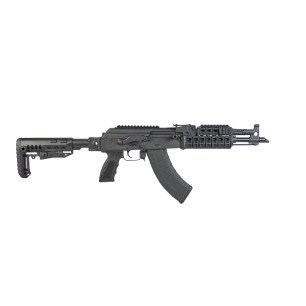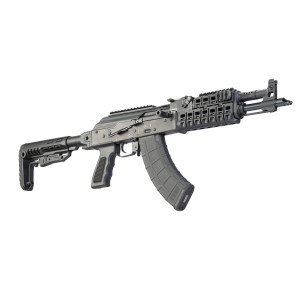

Two shooters, the same weapon… and yet incomprehensible results
Imagine the scene.
One Saturday morning, two shooters take their places at an outdoor range. The conditions are ideal: almost no wind, steady lighting, mild temperature.
The two men are using exactly the same platform.
Same rifle.
Same 18-inch barrel.
Evenoptics tighten to the recommended torque.
Same premium manufactured ammunition.
Distance: 300 meters.
The first shooter lands five shots in a tight grouping that would make any precision enthusiast smile.
The second achieves a dispersion almost four times greater.
The first reaction is always the same.
One immediately accuses:
- the quality of the ammunition ;
- the adjustment of theglasses ; ;
- the shooter's level ;
- sometimes even a mechanical defect of the weapon.
However, there is a parameter often completely ignored that can explain a large part of this phenomenon.
This parameter is located inside the barrel itself.
Invisible.
Silent.
But absolutely decisive.
His name: the scratch-free step.
And contrary to what many imagine, its influence goes far beyond the simple question of accuracy.
The most widespread belief in modern shooting
Ask ten shooters what the twist rate is.
The majority will answer:
It is used to spin the ball so that it is more accurate.
This answer is not wrong.
But it is terribly incomplete.
The groove pitch also influences:
- the gyroscopic stability of the projectile ;
- The compatibility between the cannon and certain warheads ;
- long-range ballistic behavior ;
- efficiency in the transonic zone ;
- the optimal choice in recharging ;
- sometimes even the internal pressure developed.
In other words:
Many shooters invest thousands of euros in their equipment… while ignoring one of the most important mechanical parameters.
Let's go back inside the barrel.
To understand, you need to visualize what happens during the shot.
Inside the barrel are helical grooves.
These stripes have a simple function:
print a rotation to the projectile.
This rotation creates what is called a gyroscopic stabilization.
Let's take a simple example.
A marked cannon:
1:8
means that the projectile makes a complete rotation every 8 inches traveled.
A cannon:
1:12
imposes a slower rotation.
The logic is therefore simple.
The smaller the number:
the faster the projectile spins.
But this rotation speed must correspond precisely to the projectile used.
And that's where the problems begin.
Why does a projectile absolutely need to spin?
Take a rugby ball.
Launch it without spin.
Its trajectory becomes unstable.
Now, launch it with a clean spin.
He keeps his axis.
The projectile works exactly on the same physical principle.
Without sufficient rotation:
- it oscillates ;
- it loses its longitudinal axis ;
- its drag increases ;
- Its accuracy drops sharply.
This stability becomes critical as soon as the distance increases.
At short distance, some defects go unnoticed.
At 400 or 600 meters, they become obvious.
The weight of the ball only tells part of the story.
We often read:
canon 1:7 = heavy bullets
canon 1:12 = light bullets
This simplification poses a problem.
The truly critical factor is not just the weight.
It is especially:
the length of the projectile.
Two projectiles of identical weight can have:
- different profiles ;
- a different length ;
- a different center of gravity.
Classic example.
Two 77-grain bullets.
One has an HPBT match profile.
The other is a monolithic copper projectile.
The second one will often be longer.
It will generally require more rotation.
Weight alone is therefore never enough.
The science behind the phenomenon: gyroscopic stability
In modern ballistics, this is often measured using the gyroscopic stability coefficient, called SG.
In short:
- SG less than 1 = unstable projectile
- SG between 1.4 and 2 = ideal zone
- Too high SG = possible excessive rotation
This value depends on several parameters:
- length of the projectile ;
- diameter ;
- initial speed ;
- air density ;
- temperature ;
- altitude ;
- no scratches.
We can then immediately understand why two very similar configurations can produce radically different results.
The phenomenon of keyholing: when the bullet arrives sideways
Some shooters have already observed this strange phenomenon.
On the target, the impact is no longer round.
It appears oblong.
Sometimes almost lateral.
This is called:
The term "keyholing" in English typically refers to a phenomenon in welding where the weld pool penetrates deeply into the material, creating a narrow, keyhole-shaped cavity. This technique is often used in laser welding and electron beam welding to achieve deep and narrow welds. If you need a translation of the French term "keyholing" or a specific context, please provide more details..
The projectile has lost its stability.
It no longer arrives perfectly aligned.
Common causes:
- no scratch unsuitable ;
- insufficient speed ;
- projectile too long ;
- gyroscopic coefficient too low.
At this stage:
The accuracy collapses completely.
Why do rechargers know this problem perfectly?
Reloading often highlights this phenomenon.
Let's take a charger operating at .223 Remington.
He tests:
- 23 grains of powder ;
- 24 grains ;
- 24.5 grains ;
- several total lengths.
After several sessions:
no satisfactory grouping.
He changes:
- primer ;
- ogive mark ;
- crimping.
Still bad.
The problem ?
The scale model is 1:12.
The bullet used requires a 1:8 twist rate.
All this reloading work becomes useless.
This situation is extremely common.
Case study: AR15 platform in .223 Remington
Here is a concrete example.
Canon 1:12
Generally optimized for:
- 40 grains
- 45 grains
- 50 grains
- 55 grains
Canon 1:9
Versatile:
- 55 grains
- 62 grains
- 69 grains
Canon 1:8
Very versatile:
- 62 grains
- 69 grains
- 75 grains
- 77 grains
Canon 1:7
Often used for:
- long projectiles ;
- heavy ammunition ;
- professional applications.
This table alone explains a lot of the problems observed in the field.
Over-stabilization also exists.
We often talk about a projectile that does not spin enough.
But the opposite exists.
A projectile spinning excessively fast may undergo:
- greater mechanical constraints ;
- less optimal behavior over long distances ;
- slight loss of aerodynamic efficiency.
On some fragile projectiles, one can even observe degradation in flight.
The phenomenon remains rarer.
But it really exists.
Long distance: where the problem becomes brutal
At 50 meters:
Many errors remain invisible.
At 100 meters:
The first discrepancies appear.
At 600 meters:
The mechanical truth becomes impossible to hide.
An imperfectly stabilized projectile exhibits:
- vertical dispersion ;
- lateral dispersion ;
- faster energy loss ;
- erratic behavior.
That is why TLD practitioners always analyze the rifling twist rate before purchasing a barrel.
Never again.
The perfect cannon does not exist.
Manufacturers have to make compromises.
Let's take a manufacturer offering a rifle in .308 Winchester.
He must choose a step capable of functioning properly with:
- 147 grains FMJ ;
- 168 grains match ;
- 175 grains HPBT ;
- sometimes other projectiles.
He therefore generally chooses:
a versatile compromise.
But that means one important thing.
Your cannon is probably not optimized for ALL types of ammunition.
This reality often surprises.
Even the weather can influence stability.
Few shooters know it.
The temperature changes:
- air density ;
- aerodynamic drag ;
- behavior of the projectile.
Altitude also has an effect.
A projectile that is perfectly stable at ground level may exhibit slightly different behavior at altitude.
Long-distance competitors constantly monitor these parameters.
What this changes for a typical sport shooter
Even without practicing TLD, this knowledge remains important.
A shooter looking to improve their groupings must understand that before blaming:
- his/her glasses ; ;
- his relaxation;
- his/her position ;
He sometimes has to analyze the internal mechanical compatibility.
We often observe:
A shooter changes optics for 800 euros…
while the problem comes from a projectile poorly suited to the barrel.
Educational section: the basics of shooting remain a priority
Attention.
Even with the best barrel on the market:
No mechanism can compensate for poor technique.
The fundamentals always remain dominant.
The shooter must continue to work:
Position
A stable platform reduces unwanted errors.
Breathing
Poorly controlled breathing moves the weapon before firing.
Let go
A flick of the finger completely ruins the mechanical potential.
Follow Through
The maintenance after departure influences regularity.
The best ballistics in the world do not correct a human technical error.
Common mistakes observed among shooters
We constantly find:
- Choose ammunition without knowing the twist rate of the barrel ;
- to believe that weight alone is enough ;
- to blame the optics too quickly ;
- change the equipment instead of analyzing the mechanics ;
- ignore gyroscopic stability phenomena.
These mistakes sometimes cost hundreds of euros unnecessarily.
Why do professionals place so much importance on the twist rate?
In professional environments, ballistic engineers systematically analyze:
- projectile ;
- speed ;
- ballistic coefficient ;
- terminal behavior ;
- flight stability.
The groove pitch becomes one of the first parameters studied.
This logic is found today in modern sport shooting.
FAQ:
How can I determine the rifling twist rate of my barrel ?
The manufacturer usually indicates it on the technical data sheet or sometimes directly on the barrel.
Is a scratch step that is too fast dangerous ?
Not necessarily, but it can degrade certain performances.
Why does my rifle group poorly despite using good ammunition ?
The compatibility between the projectile and the barrel may be the issue.
Is the bullet weight enough to choose ammunition ?
No. The length of the projectile often remains greater.
Does a long barrel replace a good twist rate ?
No. The length mainly affects the speed, not the stabilization.
Conclusion
The groove pitch probably represents one of the most misunderstood parameters in the world of modern shooting.
Invisible, rarely discussed in depth, it nevertheless influences:
- stability ;
- precision ;
- reloading ;
- ballistic behavior ;
- long-distance performance.
Two identical weapons can produce radically different results simply due to poor compatibility between the projectile and the barrel.
Understanding this mechanism not only allows for better selection of equipment.
But above all:
to stop systematically blaming the shooter… when the problem actually lies within the steel itself.
Products mentioned in this post