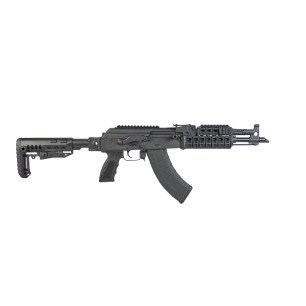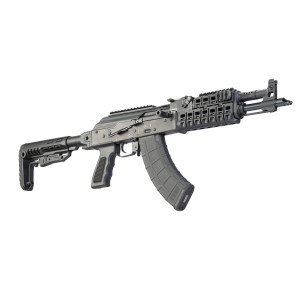

For decades, the world of armaments has relied on a relatively stable industrial logic. Steel dominated the design of mechanical parts, aluminum gradually established itself on certain modern platforms, while wood remained indispensable for a long time on traditional weapons.
For several years, a significant transformation has been accelerating.
More and more manufacturers are investing heavily in high-performance technical polymers.
Crosses, carcasses, chargers, Mechanical interfaces, control elements, or accessories: composite materials now occupy a central place in modern industry.
This development sometimes sparks debates among some enthusiasts attached to traditional materials.
However, this change responds to extremely rational technical logics.
Understanding why the industry invests so much in these new materials helps to better understand the overall evolution of modern weaponry.
Modern polymer has nothing to do with traditional plastic anymore.
The term polymer sometimes causes confusion.
Many still imagine a fragile material comparable to certain plastics standards used in other industries.
The reality is completely different.
Modern polymers used in weaponry are developed to withstand particularly significant stresses:
- violent shocks ;
- torsion ;
- heat ;
- abrasion ;
- chemical exposure ;
- prolonged aging.
Their technical level far exceeds the sometimes simplistic image that some users have of them.
Weight reduction profoundly changes the usage.
One of the first advantages concerns the weight.
Losing a few hundred grams may seem insignificant.
But on certain platforms used for several hours, this difference becomes extremely significant.
Weight reduction improves:
- maneuverability ;
- transport ;
- speed of acquisition ;
- comfort of extended use.
This logic explains why many modern weapons now incorporate more composite materials.
Resistance to external conditions
Wood and certain metals remain sensitive to various environmental aggressions.
We sometimes observe:
- corrosion ;
- humidity ;
- deformation ;
- oxidation ;
- surface aging.
Modern polymers often offer excellent resistance to:
- To the water ;
- at extreme temperatures ;
- to UV radiation ;
- to chemical products.
This stability greatly improves overall durability.
Manufacturing becomes more consistent
Modern industrial processes allow the production of extremely uniform parts.
Industrial molding offers:
- high repeatability ;
- constant tolerances ;
- better uniformity.
This precision improves:
- the assembly ;
- the consistency of production ;
- overall quality control.
Manufacturers naturally seek this level of consistency.
Industrial costs are changing
The initial development often remains costly.
But once the industrial tools are in place, production becomes more efficient.
This allows:
- faster production ;
- reduction of unit costs ;
- facilitated standardization.
In a competitive industry, these gains become strategic.
Resistance to impacts is often impressive
Some technical polymers absorb certain impacts better than more rigid materials.
During an impact:
- less permanent deformation ;
- better energy absorption ;
- reduction of certain mechanical constraints.
This feature is of particular interest to modern platforms that are used intensively.
Chargers are an excellent example.
The charger perfectly illustrates this evolution.
Many manufacturers are gradually phasing out certain all-metal designs.
Modern polymers allow:
- lightness ;
- excellent resistance ;
- controlled cost ;
- quick manufacturing.
The results obtained have largely validated this approach.
Why some users remain wary
Some enthusiasts maintain a strong preference for traditional materials.
The reasons are often:
- historical attachment ;
- perception of solidity associated with metal ;
- classical aesthetic ;
- old habits.
This perception remains understandable.
But it does not always reflect the actual performance of modern materials.
Handguns have accelerated this transition
Modern platforms have widely popularized this evolution.
The massive integration of polymers has demonstrated:
- excellent longevity ;
- mechanical reliability ;
- resistance to intensive use.
This field validation has profoundly changed the overall perception.
Integration of the basics of sport shooting
The material influences the overall behavior of a weapon.
But the fundamentals remain unchanged.
The accuracy always depends on:
- of the position ;
- of breathing ;
- of the release ;
- of stability.
A more modern weapon never makes up for poor technique.
The shooter always remains the main factor.
Innovation continues to accelerate
Manufacturers are now investing in:
- fiber-reinforced polymers ;
- hybrid materials ;
- advanced technical composites.
The objective remains constant:
improve performance while reducing hardware constraints.
This evolution is probably only just beginning.
Conclusion
The increasing integration of high-performance polymers reflects the logical evolution of the modern industry.
These materials allow:
- weight reduction ;
- better environmental resistance ;
- more consistent manufacturing ;
- optimized costs ;
- excellent durability.
Even though some users remain attached to traditional materials, the trend now seems irreversible.
In the world of modern weaponry, innovation comes as much from mechanics as from the materials themselves.
Understanding this evolution makes it possible to anticipate what the platforms of tomorrow will likely be.
Products mentioned in this post