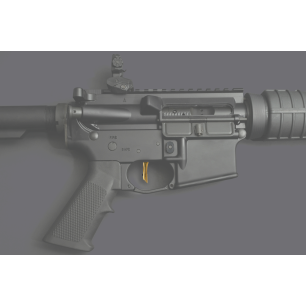

When a shooter seeks to improve their accuracy, they generally focus their attention on several visible elements: position, breathing, optics or even the quality of the ammunition.
However, a much more subtle detail regularly causes a significant deterioration in results: the placement of the finger on the trigger.
This flaw affects both beginners and some more experienced practitioners.
A simple misalignment of a few millimeters can be enough to cause:
- lateral gaps ;
- blows of / hits of / strikes offinger ; ;
- uncontrolled departures ;
- a loss of regularity that is difficult to understand.
The problem is that this error often goes completely unnoticed.
Understanding how the trigger action really works often allows for quick improvement without changing the weapon, the optics, or the ammunition.
The relaxation constitutes the last contact with the shot
At the moment the shot is fired, the finger becomes the last mechanical element connecting the shooter to the weapon.
Everything that was correctly executed before can be compromised during this last fraction of a second.
The shooter can have:
- an excellent position ;
- a perfectly controlled breathing ;
- a steady aim ;
but ruin his shot at the exact moment of the start.
This reality explains why work on relaxation represents one of the major fundamentals of sport shooting.
Many instinctively place their finger incorrectly.
For many beginners, natural positioning is rarely optimal.
We often observe:
- a finger pushed in too far ;
- a contact only at the fingertip ;
- an incorrect angle.
These errors create unintended lateral traction.
The weapon no longer recoils perfectly along its natural axis.
Understanding the mechanics of movement
The ideal goal remains extremely simple.
The finger must apply a perfectly linear pressure backward.
The movement must:
- remain gradual ;
- Avoid any lateral pulling ;
- do not disrupt the overall alignment.
As soon as an external force appears, the weapon moves slightly even before the shot is fired.
The shooter often does not perceive this micro-movement.
The target, on the other hand, records it immediately.
The problem of the finger pressed in too far
When the finger penetrates too far into the trigger guard:
- The joint exerts a lever effect ;
- The pressure becomes oblique ;
- the weaponundergoes lateral traction.
The start of the stroke becomes less clean.
This error remains extremely common.
It often causes delayed impacts without any apparent explanation.
The problem of the finger being too far outward
Conversely, some shooters use only the fingertip.
The contact then becomes unstable.
We often observe:
- a lack of control ;
- a sensation of a sudden departure ;
- a difficulty in maintaining consistency.
The release loses fluidity.
The first phalanx: the most common starting point
In most cases, the ideal contact area is located at the level of the first phalanx.
This position generally allows:
- a more direct pressure ;
- better control ;
- a more natural movement.
But each body shape remains different.
The hand, the size of the weapon, and the geometry of the trigger influence the final placement.
The "finger slip": a classic mistake
The famous finger poke remains one of the most common mistakes.
It appears when the shooter:
- anticipate the setback ;
- brutally accelerates the departure ;
- contracts the hand excessively.
Result:
The weapon moves just before the shot.
This mistake often repeats itself unconsciously.
Why does the brain naturally anticipate?
Recoil is a perfectly normal reaction.
The brain knows that an important movement is going to happen.
He sometimes tries to anticipate it unconsciously.
This anticipation causes:
- tension ;
- parasitic movement ;
- break in the movement.
The more the shooter tries to force the start, the more the problem increases.
The importance of a gradual start
A good release should slightly surprise the shooter.
The ideal departure remains:
- progressive ;
- constant ;
- without brutality.
The brain must not "order" the departure.
It must simply accompany a gradual increase in pressure.
Simple exercises to do
Several exercises can quickly correct this defect.
Dry work:
- stable aim ;
- slow pressure ;
- observation of movement.
Exercise on socket:
Place a small object on the barrel and check that it does not fall off during the action on the trigger.
Work in slow sets:
Prioritize the quality of the start rather than the pace.
Integration of the basics of sport shooting
The work of relaxation cannot be isolated.
It still works with:
- position ;
- breathing ;
- stability ;
- aimed.
A good opening move simply constitutes the culmination of a correct sequence.
All the fundamentals must remain consistent.
Why do experienced shooters continue to work on this point?
Even after several years of practice, this detail remains essential.
Many experienced shooters regularly come back to work:
- the release ;
- the placement of the finger ;
- the quality of the start.
A small technical drift can reappear quickly.
The work on the foundations is never truly finished.
Conclusion
Placing the finger on the trigger seems like a minor detail.
In reality, it directly influences the final accuracy.
A poor positioning can cause:
- repeated discrepancies ;
- a poor regularity ;
- errors that are difficult to understand.
Before questioning:
- the weapon ;
- ammunition ;
- optics ;
It is often useful to observe this simple gesture.
In shooting sports, sometimes just a few millimeters are enough to completely change the results.